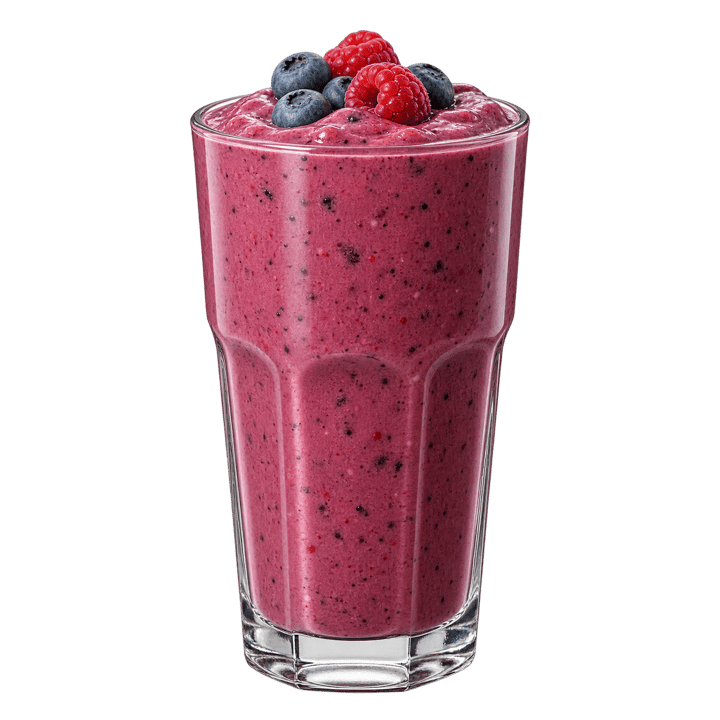
How much protein should be in a protein shake?
On this page
About 0.4 g of protein per kg of your body weight, rounded to the nearest 5. That’s 25 g at 140 lb, 30 g at 165 lb and 35 g at 180 lb. Treat it as a floor, since more isn’t wasted. The Gyroscope app personalizes yours.
Two ideas pull people in opposite directions. One says your body can only use 20 to 30 g of protein at a time, so a bigger shake is money down the drain. The other says more is always better, so two scoops must beat one. The first is out of date, and both miss that the right amount depends on your weight.
What we’d do
Put your meal line in every shake that stands in for a meal, using milk and Greek yogurt first and a scoop where you need it. If you want more after a hard workout, have it. Going over the line costs calories, and the muscle still uses it.
Think of the line like the minimum on a credit card bill. Paying it keeps you on track, and paying more never hurts.
What’s my number?
Your line is 0.4 g per kg of your weight, rounded to 5. If you have more than a fifth of your weight to lose, count from your goal weight plus a fifth of what you weigh now, the same rule our other guides use.
| You weigh | Your line per shake | Your day, at 1.2 to 1.6 g per kg |
|---|---|---|
| 120 lb | 20 g | 65 to 85 g |
| 140 lb | 25 g | 75 to 100 g |
| 165 lb | 30 g | 90 to 120 g |
| 180 lb | 35 g | 100 to 130 g |
| 220 lb | 40 g | 120 to 160 g |
| 250 lb aiming for 180 | 40 g (counted from 230 lb) | 125 to 165 g |
The day’s range is the 2025 to 2030 US guidelines’ 1.2 to 1.6 g per kg, and they ask for protein at every meal. Split the low end over three meals and you get the same 0.4 g per kg. The protein shake calculator does this for your weight and sizes the scoop to match.
Where does 0.4 g per kg come from?
From a 2018 review by Brad Schoenfeld and Alan Aragon, two researchers who study muscle growth. They went through the research behind the “20 to 25 g at a time” idea and found it came from lab studies that gave people a fast-digesting protein on its own. Protein eaten with other food is absorbed more slowly, and the body puts more of it to use. They proposed 0.4 g per kg at each of at least four meals as a practical target for building muscle.
Is a bigger shake wasted?
No. In 2023, Dutch researchers gave 36 young men either 25 g or 100 g of milk protein after a whole-body workout and traced where it went with labeled amino acids. The 100 g dose kept muscle building going for more than 12 hours and gave a bigger response overall, and very little of the extra protein was burned off. It was one session, in men, so it tells you a big dose gets used, and says nothing about whether 100 g a day builds more muscle over months.
The practical upshot is that the line is a minimum. A 40 g shake at 165 lb puts the extra 10 g toward the rest of your day.
How do I hit it?
| In the glass | Protein |
|---|---|
| 1 cup 2% milk | 8 g |
| 7 oz plain nonfat Greek yogurt | 20 g |
| 1/2 cup 1% cottage cheese | 14 g |
| 1 scoop whey (32 g) | 25 g |
| 1 cup unsweetened soy milk | 7 g |
A cup of milk and 7 oz of Greek yogurt is 28 g, close enough to a 30 g line once the fruit and a spoon of peanut butter add a few more. The Ultimate has 40 g with one full scoop. protein.guide covers the rest of the day.
5 sources
- Schoenfeld BJ and Aragon AA, How much protein can the body use in a single meal for muscle-building? Implications for daily protein distribution, Journal of the International Society of Sports Nutrition, 2018pmc.ncbi.nlm.nih.gov
- Trommelen J et al., The anabolic response to protein ingestion during recovery from exercise has no upper limit in magnitude and duration in vivo in humans, Cell Reports Medicine, 2023pmc.ncbi.nlm.nih.gov
- US Department of Agriculture and US Department of Health and Human Services, Dietary Guidelines for Americans, 2025 to 2030, January 2026cdn.realfood.gov
- USDA SR Legacy, whey protein powder (FDC 173180)fdc.nal.usda.gov
- USDA SR Legacy, milk, reduced fat, 2% (FDC 171267)fdc.nal.usda.gov