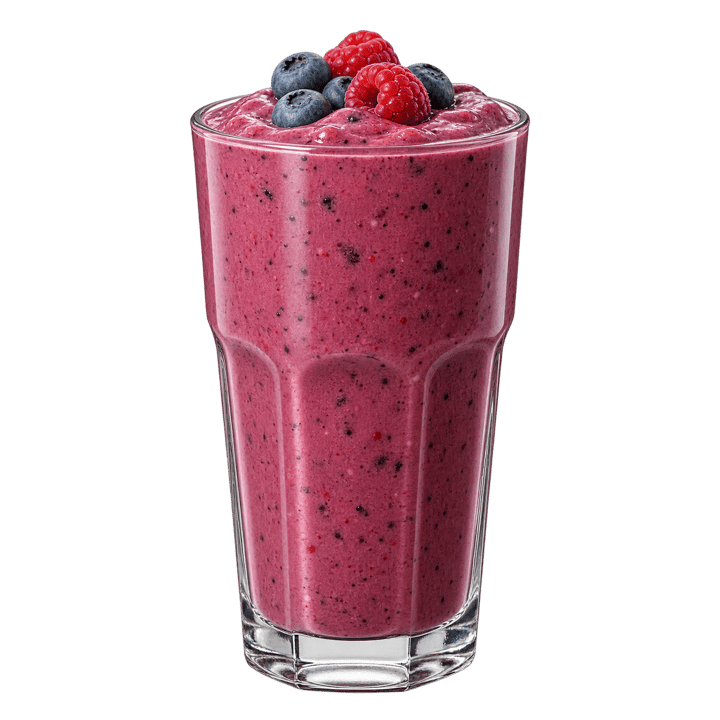
How do you use a smoothie to lose weight?
On this page
Drink the smoothie in place of a meal, never next to one, and build it like a meal: about 30 g of protein, a spoon of chia or oats, whole fruit, no juice or honey, and about a meal’s calories. Across 23 trials, diets that swapped some meals for shakes lost about 3 lb (1.4 kg) more at a year than other diets.
Search for a weight loss smoothie and you’ll find “fat burning” glasses with green tea, ginger, cinnamon and apple cider vinegar, each promising to melt something. People make one, feel virtuous, and drink it with their usual breakfast. No ingredient in a blender burns fat. What a smoothie can do is replace a meal with something that fills you on fewer calories, and that’s the part the trials tested.
What we’d do
Replace one meal a day, usually breakfast, with a glass built as a meal. Pick one of the glasses below, drink the same one most mornings so you know its numbers, and keep the rest of the day real food. Never add a smoothie as a snack on top. If you’re hungry by eleven, make the glass bigger or thicker before you give up on it.
If you remember three things
- Replace, never add. The trials that worked had shakes take the place of meals.
- A drink added on top tends to be extra calories. People who drank 450 calories of soda a day ate no less of anything else.
- Protein is what makes it hold. About 30 g at 165 lb. The Gyroscope app personalizes yours.
Swapping lunch, not adding one
Swapping your usual lunch order for a smoothie is a different thing from ordering a second lunch. Everyone knows that about food. With drinks it’s easy to forget, because a smoothie feels like a health habit rather than a meal.
In a study published in 2000, Mattes’s lab at Purdue gave 15 adults an extra 450 calories a day for four weeks, once as soda and once as jelly beans, with a month off in between. With the jelly beans, they ate less of everything else, enough to make up for all of it. With the soda, they ate no less, so the calories were all extra, and their weight and BMI went up only in the soda weeks.
A smoothie isn’t soda, and the study was small. But it’s why we treat a smoothie as a meal or nothing. A 2018 study at the University of Bristol found drink calories did count when a meal came right after, and the effect was mostly gone two hours later. A glass at 10 am, two hours after breakfast and two before lunch, is in the worst place.
The trials that worked
In 2019 Nerys Astbury and her colleagues at the University of Oxford pulled together every randomized trial they could find that compared a diet with meal replacements against a diet without them, and followed people for at least a year. They found 23 trials with 7,884 adults with overweight or obesity. The meal replacements were products like shakes, bars and soups, used in place of at least one meal a day, with at least one ordinary meal kept.
At one year, the people on meal replacements had lost more in every comparison. Against other diets, they lost 1.44 kg (about 3 lb) more, with a range of 0.39 to 2.48 kg. When both groups got the same support, the gap was 2.22 kg. The biggest gap, 6.13 kg, came when the meal replacement group also got extra coaching, so part of that was the coaching. Diets that replaced all food or went under 800 calories a day were left out.
We’re confident that replacing a meal with a well-built shake helps people lose weight. What nobody has tested is a homemade glass, so we build ours to look like the ones that worked: a fixed recipe, known calories and enough protein to last.
Size it to your meal
Your meal’s calories are your day’s calories over your meals. On a weight loss day, that’s smaller. Find your day on tdee.guide’s calories to lose, then divide by three.
| Calories a day | One meal, give or take a quarter |
|---|---|
| 1,600 | 400 to 670 |
| 2,000 | 500 to 830 |
| 2,400 | 600 to 1,000 |
At 1,600 a day, seven of our top ten land inside the window, and every one of them clears all six meters. Here are four:
| Glass | Calories | Protein | Fiber | Grade |
|---|---|---|---|---|
| The Ultimate, chocolate peanut butter | 448 | 41 g | 9 g | A |
| Plant, soy and berry | 462 | 33 g | 10 g | A |
| The bowl, with a spoon | 461 | 31 g | 11 g | A |
| Peanut butter banana oat, no powder | 564 | 35 g | 9 g | A |
A glass a little under the window, like the strawberry banana yogurt one at 396 calories, is fine if it holds you until the next meal. If it doesn’t, add a spoon of oats or chia before anything sweet.
Compare the chain version. A 20 oz Hulk Strawberry at Smoothie King has 820 calories, 85 g of added sugar and 23 g of protein. The peanut butter banana oat glass has about two thirds of the calories, more protein and no added sugar.
Which meal to replace
Breakfast is the easiest for most people. It’s the meal that’s already short on protein, with about 15 g in the average American breakfast by USDA’s survey, and it’s the one most people eat in a rush. Lunch works too if that’s where you usually grab something.
When you eat makes little difference to weight loss on its own. In trials, being told to eat breakfast or skip it didn’t change how much people lost, as bodyfat.guide’s breakfast myth shows. Pick the meal that’s hardest to get right, and replace one meal, not all three.
Keep the muscle
Losing weight also costs some muscle, and protein is one of the main things that protects it. A glass at your meal line covers one meal of it. For your whole day’s range, bodyfat.guide’s protein calculator and how much protein do I need to lose fat? have the numbers. Lifting weights helps keep it too.
What doesn’t help
- Fat burning ingredients. Green tea, ginger, cinnamon or vinegar won’t make up for a glass with no protein in it. Protein, fiber and a meal’s calories do the work.
- Juice and honey. A cup of orange juice adds 21 g of sugar and almost no fiber. A tablespoon of honey adds 17 g of added sugar, past the 10 g the US guideline allows a whole meal.
- A big chain cup on top of breakfast. It’s two meals.
Same glass, every morning
The meal replacements in those trials were packaged products with the same calories every time, and a homemade glass can work the same way. Make the same one most mornings and you know exactly what it carries. If you log it, Gyroscope makes that easy: snap your shake once, then log it every morning with one tap.
7 sources
- Astbury NM et al., A systematic review and meta-analysis of the effectiveness of meal replacements for weight loss, Obesity Reviews, 2019pmc.ncbi.nlm.nih.gov
- DiMeglio DP and Mattes RD, Liquid versus solid carbohydrate: effects on food intake and body weight, International Journal of Obesity, 2000pubmed.ncbi.nlm.nih.gov
- Rogers PJ and Shahrokni R, A comparison of the satiety effects of a fruit smoothie, its fresh fruit equivalent and other drinks, Nutrients, 2018pmc.ncbi.nlm.nih.gov
- US Department of Agriculture and US Department of Health and Human Services, Dietary Guidelines for Americans, 2025 to 2030, January 2026cdn.realfood.gov
- USDA Agricultural Research Service, What We Eat in America, NHANES August 2021 to August 2023, Table 13, breakfastars.usda.gov
- Smoothie King, The Hulk Strawberry, 20 oz, menu page, opened November 14, 2026smoothieking.com
- USDA FoodData Central, SR Legacy rows by FDC ID (the top ten recipes' ingredients), opened on nutritionvalue.orgnutritionvalue.org