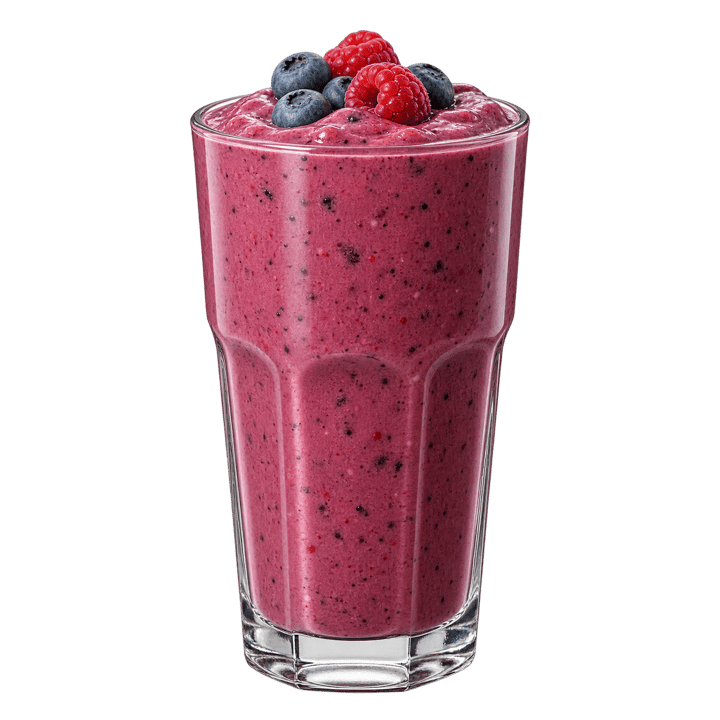
What's in a protein powder?
On this page
A protein powder is protein from milk, soy or peas, dried into a scoop. It’s handy and never needed. In Consumer Reports’ 2025 tests, more than two thirds of 23 powders and shakes had more lead in one serving than its cautious daily level, and plant powders averaged about nine times the lead of dairy ones. We’d use food first, then a dairy powder, and not every day.
Protein powder gets two opposite reputations. In the gym it’s the healthy part of the shake, the thing that makes it a protein shake at all. Online, after the 2025 lead tests, it’s poison. Neither is right, and the useful answer for a smoothie sits in between: a scoop is fine to have, food does the same job, and which powder you pick and how often you use it make a real difference.
What we’d do
Get your protein from food most days: milk, Greek yogurt, cottage cheese, soy milk or tofu. When a scoop is easier, use a dairy one, like whey, and not every day. Go by the grams of protein on the label, not the scoop. If you’re pregnant, or making a glass for a child, leave the powder out.
If you remember three things
- You don’t need a powder. A cup of 1% cottage cheese has 28 g of protein.
- Dairy powders tested lowest for lead. Plant ones averaged about nine times as much, in Consumer Reports’ 2025 tests.
- Not every day. That’s Consumer Reports’ own advice for most powders.
What’s in the tub
A scoop of protein powder is to a glass what a frozen pizza is to dinner. It’s handy on a busy morning, fine now and then, and not what you’d want every day.
Whey and casein both come from milk. Soy and pea come from plants. A 32 g scoop of whey in USDA’s record has 113 calories, 25 g of protein, 2 g of carbs and half a gram of fat. Scoops differ a lot between brands, so the grams on your label are what count.
The difference between them is mostly leucine, an amino acid that helps switch on muscle building. In a 2018 lab analysis of protein isolates, whey was about 11% leucine, and soy and pea about 7%. To get the 2.7 g of leucine in 25 g of whey, you’d need about 40 g of soy protein or 38 g of pea.
In muscle trials the gap mostly disappears with soy. A 2025 review of 43 trials found plant protein built a little less muscle than animal protein overall, but soy matched milk across 17 trials. Pea and other plant powders have less behind them.
The 2025 lead tests
In October 2025, Consumer Reports published its first test of protein powders and shakes in 15 years. It bought 23 products from stores and online, tested several lots of each, and compared the lead in one serving with a level of concern of 0.5 micrograms a day. That level is California’s Prop 65 limit, which CR describes as having “a wide safety margin built in”.
- About 70% of the products had more than 120% of that level in a single serving.
- Plant-based products averaged about nine times the lead of those made with dairy proteins like whey, and twice as much as beef-based ones.
- Two plant powders had so much that CR advised against using them at all: Naked Nutrition’s Vegan Mass Gainer at 7.7 micrograms a serving (about 1,570% of the level) and Huel’s Black Edition at 6.3 micrograms (about 1,290%).
- Dairy powders and shakes generally had the lowest amounts, though some were still over the level.
- Every product had at least the protein its label claimed, between 20 and 60 g a serving.
CR’s advice was plain: “We advise against daily use for most protein powders.” It also said “there’s no reason to panic”, and that even the worst products “are far below the concentration needed to cause immediate harm.” There are no federal limits for heavy metals in protein powder, and supplements aren’t tested by the FDA before they’re sold.
After readers asked about other brands, CR tested five more powders and updated the article in January 2026.
What it means for your glass
The worry with lead is repeated exposure, not one scoop. A powder every morning is a dose every morning, which is why how often you use it counts as much as which one. CR’s experts say children and pregnant people are the most vulnerable, since lead can affect the developing brain.
We’d go food first, because a cup of milk and 7 oz of Greek yogurt carry 28 g of protein with no question about metals. Then dairy, because that’s what tested lowest, and not every day, because that’s CR’s own advice. CR also suggests making your own shakes by swapping the powder for high-protein foods like Greek yogurt.
Getting to 30 g without a tub
| Glass base | Protein | Calories |
|---|---|---|
| 1 cup 1% cottage cheese | 28 g | 162 |
| 1 cup 2% milk and 7 oz plain nonfat Greek yogurt | 28 g | 239 |
| 1 cup unsweetened soy milk and 1/2 cup firm tofu | 29 g | 261 |
| 1 cup 2% milk and 6 oz plain nonfat Greek yogurt | 25 g | 222 |
Add fruit, and seeds or oats, and every one of those is a meal. The strawberry banana yogurt, cottage cheese berry and plant glasses are built on them. Tofu labels vary a lot, so check yours. How to make a protein shake without powder has the recipes, and you don’t need protein powder has more.
Reading the label
- Protein per serving, in grams. A typical scoop of whey has about 25 g. Some “servings” are two scoops.
- The serving size in grams. It tells you how much powder you’re getting for that protein.
- Sweeteners. The 2025 to 2030 US guideline says to limit low-calorie sweeteners such as sucralose, aspartame and acesulfame K. An unflavored powder lets the fruit and a spoon of cocoa do the work.
- Added sugar. Some flavored powders carry several grams. A meal’s line is 10 g.
Whey or plant?
For most people, whey. It has more leucine, and it tested lower for lead. If you don’t eat dairy, soy milk and tofu give you soy’s protein as food, and soy is the plant protein with the best trial record. Is whey or plant protein powder better? has the details, and protein.guide covers protein for the whole day.
5 sources
- Consumer Reports, Protein powders and shakes contain high levels of lead, October 14, 2025, updated January 8, 2026consumerreports.org
- Gorissen SHM et al., Protein content and amino acid composition of commercially available plant-based protein isolates, Amino Acids, 2018pmc.ncbi.nlm.nih.gov
- Reid-McCann RJ et al., Effect of plant versus animal protein on muscle mass, strength, physical performance, and sarcopenia: a systematic review and meta-analysis of randomized controlled trials, Nutrition Reviews, 2025pmc.ncbi.nlm.nih.gov
- US Department of Agriculture and US Department of Health and Human Services, Dietary Guidelines for Americans, 2025 to 2030, January 2026cdn.realfood.gov
- USDA FoodData Central, SR Legacy rows by FDC ID: whey protein powder (173180), milk, 2% (171267), Greek yogurt, plain nonfat (170894), cottage cheese, 1% (173417), soy milk (175223), firm tofu (172475), opened on nutritionvalue.orgnutritionvalue.org