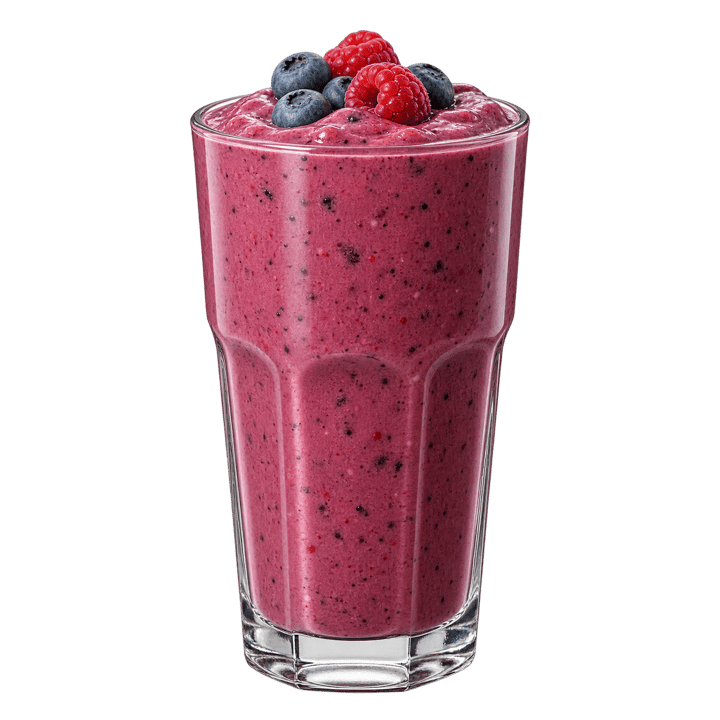
Why does a smoothie need protein, and how much?
On this page
Protein is the part that turns a glass of fruit into a meal. Aim for about 0.4 g per kg of your body weight, rounded to 5: 25 g at 140 lb, 30 g at 165 lb, 35 g at 180 lb and 40 g at 220 lb. The Gyroscope app personalizes yours.
Most people judge a smoothie by its fruit. Protein, if they think about it at all, is for bodybuilders and comes in a tub. Then there are the two rumors from the gym: that your body can only use 30 g at a time, so anything more is wasted, or that more is always better. Both miss what protein does in a breakfast glass, which is to make it last until lunch.
What we’d do
Put your meal line in every glass you drink as a meal, and get most of it from food: a cup of milk plus 7 oz of Greek yogurt is 28 g, a cup of cottage cheese is 28 g. Use a scoop of powder when it’s easier, a dairy one, and not every day. If your glass goes over the line, that’s fine, since a bigger dose isn’t wasted.
If you remember three things
- Your line is about 0.4 g per kg. 30 g for a 165 lb adult. The Gyroscope app personalizes yours.
- The average American breakfast has about 15 g. A smoothie is the easiest place to double it.
- Over the line isn’t wasted. In a 2023 study, 100 g kept muscle building going for over 12 hours.
What’s missing from most glasses
Think of protein in a glass the way you think of the main dish on a plate. Nobody calls a bowl of fruit salad dinner. Add a piece of chicken or a scoop of cottage cheese and it starts to look like a meal.
Most fruit smoothies are the fruit salad. A 20 oz Caribbean Way at Smoothie King has 2 g of protein. A glass of banana, strawberries and orange juice made at home has about 4 g. Both feel like breakfast and neither has much in it to keep you going.
That gap shows up in what Americans eat anyway. US adults eat about 77 g of protein a day, and 19% of it at breakfast, according to USDA’s What We Eat in America survey for 2021 to 2023. That’s about 15 g in the morning, half a 165 lb adult’s meal line.
How much is your meal line?
The 2025 to 2030 US Dietary Guidelines set protein at 1.2 to 1.6 g per kg of body weight a day, under the heading “Prioritize Protein Foods at Every Meal”. Split the low end over three meals and you get 0.4 g per kg a meal. A 2018 review by Brad Schoenfeld and Alan Aragon came to the same number from the muscle side: 0.4 g per kg a meal, over at least four meals, for people trying to build muscle.
| Your weight | Your meal line |
|---|---|
| 120 lb | 20 g |
| 140 lb | 25 g |
| 165 lb | 30 g |
| 180 lb | 35 g |
| 200 lb | 35 g |
| 220 lb | 40 g |
| 250 lb | 45 g |
If you have more than a fifth of your weight to lose, the line comes from your goal weight plus a fifth of today’s weight, the same rule bodyfat.guide uses. These are typical ranges, and the Gyroscope app personalizes yours. For the day as a whole, bodyfat.guide’s protein calculator gives your range, and protein.guide covers every meal.
What 30 g looks like in a glass
| Source | For 30 g of protein | Calories |
|---|---|---|
| Whey powder | 1.2 scoops (38 g) | 136 |
| Plain nonfat Greek yogurt | 10.4 oz | 173 |
| 1% cottage cheese | about 1 cup | 174 |
| Firm tofu | about 2/3 cup | 249 |
| Unsweetened soy milk | 4.3 cups | 343 |
| 2% milk | 3.7 cups | 455 |
| Peanut butter | 8 tbsp | 800 |
| Unsweetened almond milk | 29 cups | 1,114 |
Peanut butter is the surprise. People call a peanut butter banana smoothie a protein shake, but a tablespoon has 3.6 g of protein and 96 calories, so you’d need about eight of them, 800 calories, to reach 30 g. Almond milk has about 1 g a cup. Use them for flavor and fat, and get the protein from milk, yogurt, cottage cheese, soy or a scoop.
Tofu labels vary a lot. USDA has two firm tofu records, one at about 22 g of protein in half a cup and one at about 9 g per 100 g, so check the one in your fridge.
Powder or no powder
You can reach your line without a tub. A cup of 1% cottage cheese has 28 g. A cup of 2% milk and 7 oz of plain Greek yogurt have 28 g together. Seven of the top ten have no powder at all.
A scoop is handy, and whey is the best tested. But Consumer Reports’ 2025 tests found lead in a lot of powders, plant ones most of all, and advised against daily use for most of them. Our position is food first, then a dairy powder, and not every day. What’s in a protein powder has the tests in full, and you don’t need protein powder has the glasses without it.
Why a bigger glass isn’t wasted
The idea that your body can only use 20 to 30 g at a time came from lab studies that gave people a fast protein drink on its own, after a workout. Schoenfeld and Aragon’s review found that more than that is burned for energy at a higher rate, but not all of it, and some still goes into tissue.
A 2023 study tested it head on. Researchers gave 36 young men 0, 25 or 100 g of milk protein after a whole-body workout, 12 men in each group, and traced where it went. The 100 g dose gave a bigger muscle building response, and it lasted more than 12 hours. It was one session in young men, so it doesn’t tell you how much muscle anyone would build over months, but it shows that a glass over your line doesn’t throw the extra away.
When you drink it changes less than people think. A 2025 review of five trials found that protein before or after each workout made no difference to the lean mass people gained. Before or after a workout? has the details.
The Ultimate, sized to you
The Ultimate is our chocolate peanut butter shake: a cup of 2% milk, a scoop of whey, half a frozen banana, a tablespoon each of peanut butter, cocoa and ground flax, two cups of spinach, and ice. Everything but the scoop already carries about 16 g of protein. So at 140 lb half a scoop reaches the line (29 g in the glass), at 165 and 180 lb three quarters (35 g), and from about 210 lb up a full scoop (41 g). How much protein should my shake have? scales the scoop to your weight and your powder’s label.
9 sources
- US Department of Agriculture and US Department of Health and Human Services, Dietary Guidelines for Americans, 2025 to 2030, January 2026cdn.realfood.gov
- Schoenfeld BJ and Aragon AA, How much protein can the body use in a single meal for muscle-building? Implications for daily protein distribution, Journal of the International Society of Sports Nutrition, 2018pmc.ncbi.nlm.nih.gov
- Trommelen J et al., The anabolic response to protein ingestion during recovery from exercise has no upper limit in magnitude and duration in vivo in humans, Cell Reports Medicine, 2023pmc.ncbi.nlm.nih.gov
- Casuso RA and Goossens L, Does protein ingestion timing affect exercise-induced adaptations? A systematic review with meta-analysis, Nutrients, 2025pmc.ncbi.nlm.nih.gov
- USDA Agricultural Research Service, What We Eat in America, NHANES August 2021 to August 2023, Table 13, breakfastars.usda.gov
- USDA Agricultural Research Service, What We Eat in America, NHANES August 2021 to August 2023, Table 1, nutrient intakesars.usda.gov
- USDA FoodData Central, SR Legacy rows by FDC ID: milk, 2% (171267), soy milk (175223), almond milk (174832), Greek yogurt, plain nonfat (170894), cottage cheese, 1% (173417), whey protein powder (173180), firm tofu (172475), peanut butter (172470), opened on nutritionvalue.orgnutritionvalue.org
- Consumer Reports, Protein powders and shakes contain high levels of lead, October 14, 2025, updated January 8, 2026consumerreports.org
- Smoothie King, The Caribbean Way, 20 oz, menu page, opened November 14, 2026smoothieking.com