Should I drink a protein shake before or after a workout?
Either. In a 2025 review of five trials that compared the two head to head, protein before or after training made no difference to the muscle people built. The protein you eat across the day does the work, so drink the shake whenever it fits your routine.
For years the rule in every gym was the anabolic window, the idea that you have half an hour or so after training to get protein in, or the session goes to waste. It’s why so many people chug a shake in the locker room before they’ve even showered. The trials that tested it found the window is a lot wider than that, if it’s there at all.
What we’d do
Drink it when it suits you, before, after, or as breakfast an hour later. If the shake replaces a meal, build it like a meal. If it’s an extra next to your meals, keep it small and mostly protein. And if you’re trying to lose weight, don’t add a shake after training on top of a breakfast you’d have eaten anyway.
It’s like saving for retirement. What you put in over the year decides how much it grows, and the day of the month you pay in barely shows.
After a workout


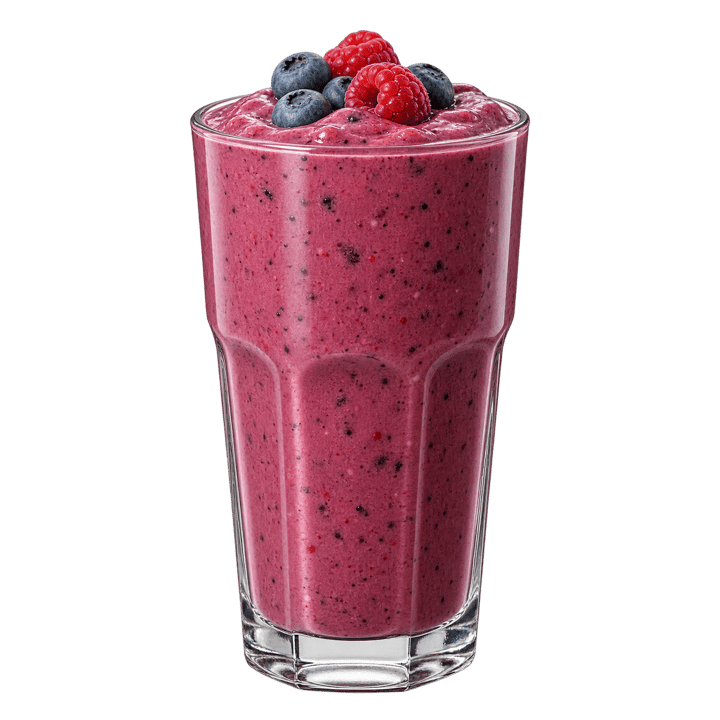
Milk, whey, banana B
34 g protein, 340 calories
What did the trials find?
Before against after, 2025
5 trials, protein before or after every session for at least 4 weeks
No difference in lean mass or in chest press strength. Leg press strength came out slightly better with protein before, but the researchers couldn’t show the two exercises really differed.
Only five trials have compared the two directly, so it’s a small pile of evidence.
Timing against total, 2013
23 trials, 525 people lifting weights
At first glance protein near a workout helped muscle grow. Once the researchers allowed for how much protein people ate in all, timing made no difference, and total protein was the strongest predictor of growth.
Only 3 of the trials gave both groups the same total protein.
How long it lasts, 2023
36 young men, one whole-body workout
100 g of protein afterwards kept muscle building going for more than 12 hours, longer than 25 g did.
One session, in men. It shows the response lasts hours, so there’s no 30-minute deadline.
Put together, the window is at least half a day wide, and the total you eat across the day and the week is what grows muscle. We’re confident about that for healthy adults who lift, since three different kinds of study point the same way.
How much protein should it have?
Your meal line, about 0.4 g per kg of body weight, which is 30 g at 165 lb. The Gyroscope app personalizes yours. Bigger isn’t wasted after a hard session, as the 2023 study showed. The US guidelines ask for 1.2 to 1.6 g per kg across the day, and a shake is an easy way to cover the meal that falls short.
A cup of milk, a scoop of whey and a banana is 340 calories and 34 g of protein. For a big training day, the peanut butter banana oat glass has 35 g of protein in a real meal’s 564 calories, with no powder.
protein.guide has the full story on the anabolic window from the protein side.
4 sources
- Casuso RA and Goossens L, Does protein ingestion timing affect exercise-induced adaptations? A systematic review with meta-analysis, Nutrients, 2025pmc.ncbi.nlm.nih.gov
- Schoenfeld BJ, Aragon AA and Krieger JW, The effect of protein timing on muscle strength and hypertrophy: a meta-analysis, Journal of the International Society of Sports Nutrition, 2013pmc.ncbi.nlm.nih.gov
- Trommelen J et al., The anabolic response to protein ingestion during recovery from exercise has no upper limit in magnitude and duration in vivo in humans, Cell Reports Medicine, 2023pmc.ncbi.nlm.nih.gov
- US Department of Agriculture and US Department of Health and Human Services, Dietary Guidelines for Americans, 2025 to 2030, January 2026cdn.realfood.gov