Why doesn't a smoothie fill me up like food?
The apple test: 58 adults, lunch plus what they had first
On this page
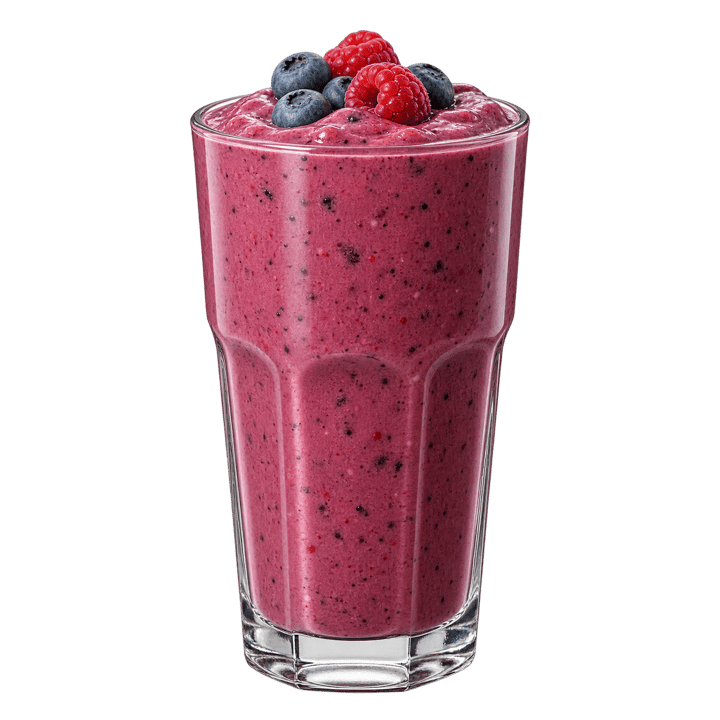
A drink leaves your stomach fast, nothing gets chewed, and most fruit smoothies have almost no protein, so you’re hungry again soon. A glass that lasts until lunch has a meal’s calories, protein at your line, enough thickness to need a spoon or a slow straw, and you sip it as the meal.
It’s one of the most common complaints about smoothies. Someone drinks a 400 calorie glass of fruit at 7:30, which on paper is a proper breakfast, and by ten they’re raiding the office snacks. It feels like a personal failing, or like the smoothie was a lie. It’s neither, because a drink works differently in your body from the same food on a plate, and once you know how, you can build around it.
What we’d do
Build the glass as a meal, then make it thick and drink it slowly. Get your protein in (30 g at 165 lb), use frozen fruit instead of ice, add a spoon of chia or oats, and use less liquid than you think. Drink it sitting down, over 10 minutes or more, as breakfast, never as a snack an hour before it.
If you remember three things
- Chewing is part of what fills you. A whole apple before lunch cut the meal by 187 calories. The same apple as juice barely moved it.
- Calories keep the stomach full, and thickness makes you feel full. A good glass has both.
- Sip it as the meal. The fullness from any drink fades within a couple of hours.
The apple test
In 2009 Barbara Rolls’s lab ran one of the neatest experiments on this. They gave 58 adults a snack of apple 15 minutes before lunch, once a week for five weeks. Each time it was 266 g and about 125 calories, eaten over 10 minutes. One week it was a whole apple, then applesauce, then apple juice, then apple juice with the apple’s own fiber stirred back in, and one week nothing at all. Then lunch, as much as they liked.
With nothing first, people ate 1,024 calories at lunch. After the whole apple they ate 709, so lunch plus the apple came to 837, about 187 fewer calories in all. After the applesauce, the total was 928. After the juice, 1,015, almost as if they’d had nothing. They felt fullest after the whole apple, then the applesauce, then the two juices.
The surprise was the fiber. Putting it back into the juice didn’t help at all. It was the same apple and the same calories, and the less chewing it took, the less it filled people up.
A meal with the chewing done for you
A smoothie sits between the applesauce and the juice. The blender has done the chewing, and the fiber is all still there, cut small. That’s why it’s fast on a busy morning, and it’s also why it holds you less than the same food on a plate.
Three things happen with a drink:
- It goes down fast. You can finish 20 oz in a few minutes, far faster than you’d eat the same fruit.
- It leaves the stomach fast. Liquid empties quicker than food you chewed, unless it’s thick or carries a lot of calories.
- It feels less like food. In a 2018 study, the more food-like a drink seemed and the more slowly people had it, the fuller they felt.
A fruit smoothie with no protein has all three working against it. A 20 oz Caribbean Way has 390 calories and 2 g of protein. A glass with 30 g of protein, chia and frozen fruit thick enough to need a slow straw is a different drink.
Thick shakes and an MRI scanner
In 2016 researchers at Wageningen University in the Netherlands put 15 healthy young men in an MRI scanner after four different dairy shakes, all 500 ml. Two were thin and two were thick, and each came at 100 or 500 calories. Every 10 minutes the scanner measured what was left in the stomach, and the men rated how full they felt.
| Shake | Half gone from the stomach after |
|---|---|
| Thin, 100 calories | 26.5 minutes |
| Thick, 100 calories | 41 minutes |
| Thin, 500 calories | 69.5 minutes |
| Thick, 500 calories | 81.9 minutes |
Calories did the most to keep the stomach full. But thickness did the most for how full people felt: at 40 minutes the thick 100 calorie shake was rated fuller (58 on a 100 point scale) than the thin 500 calorie one (48). The authors called it “phantom fullness”, because the stomach of the thick low calorie shake was emptier than it felt.
A good glass uses both. A meal’s calories keep your stomach working, and thickness makes it feel like breakfast. Only the calories decide how full a shake keeps you goes through this study in more detail.
The soda and the jelly beans
In a study published in 2000, 15 adults (7 men and 8 women) got an extra 450 calories a day for four weeks, once as soda and once as jelly beans. With the jelly beans, they ate less of everything else, and the extra calories were fully made up. With the soda, they didn’t eat any less, so the 450 calories were all extra and their weight went up.
It was soda, not a smoothie, and a small study. But it’s why we’re strict that a smoothie replaces a meal. Added on top of breakfast, its calories are likely to go uncounted by your appetite. How to use a smoothie to lose weight builds on it.
When the drink is the meal
A 2018 study by Peter Rogers and Roya Shahrokni at the University of Bristol looks, at first, like it says the opposite. They gave 47 adults about 136 calories of water, blackcurrant squash, milk, a fruit smoothie, or the smoothie’s fruit eaten whole, then a meal 2 minutes later (23 people) or 2 hours later (24 people). The whole fruit felt the most filling. But at the meal, every snack with calories in it, the drinks and the fruit alike, cut what people ate by the same amount compared with water. They made up about 82% of those calories when the meal came 2 minutes later, and only about 12% when it came 2 hours later.
A drink’s calories do count, then, as long as the meal is close behind. The fullness from any small snack fades within a couple of hours, which is why a smoothie works best as the meal itself, big enough to be one, and not as a snack before one.
The glass that lasts until lunch
- Protein at your line. 30 g for a 165 lb adult. A cup of milk and 7 oz of Greek yogurt have 28 g together.
- A meal’s calories. At 2,000 a day over three meals, about 500 to 830. A 250 calorie fruit glass is a snack.
- Thick. Frozen fruit instead of ice, Greek yogurt, a quarter cup of oats or half an ounce of chia, and less liquid.
- Sipped. Sit down with it, or eat it with a spoon as a smoothie bowl.
Build your glass puts all of this on its Hunger meter, protein, fiber and how thick the glass is, beside the other five jobs a meal does, and the quiz tells you whether yours is a meal or a dessert. meals.guide’s Hunger page has the same meter from the plate’s side, with the boiled potato that beat the croissant.
What we don’t know
These are small studies: 58 adults in the apple test, 47 in the Bristol study, 15 in each of the others. Each tested one sitting or a few weeks, and none tested a protein smoothie built the way we build ours. They all point the same way, though. meals.guide covers why some plates hold you for hours.
6 sources
- Flood-Obbagy JE and Rolls BJ, The effect of fruit in different forms on energy intake and satiety at a meal, Appetite, 2009pmc.ncbi.nlm.nih.gov
- Rogers PJ and Shahrokni R, A comparison of the satiety effects of a fruit smoothie, its fresh fruit equivalent and other drinks, Nutrients, 2018pmc.ncbi.nlm.nih.gov
- DiMeglio DP and Mattes RD, Liquid versus solid carbohydrate: effects on food intake and body weight, International Journal of Obesity, 2000pubmed.ncbi.nlm.nih.gov
- Camps G, Mars M, de Graaf C and Smeets PA, Empty calories and phantom fullness: a randomized trial studying the relative effects of energy density and viscosity on gastric emptying determined by MRI and satiety, American Journal of Clinical Nutrition, 2016pubmed.ncbi.nlm.nih.gov
- Smoothie King, The Caribbean Way, 20 oz, menu page, opened November 14, 2026smoothieking.com
- USDA FoodData Central, SR Legacy rows by FDC ID: milk, 2% (171267), Greek yogurt, plain nonfat (170894), chia (170554), opened on nutritionvalue.orgnutritionvalue.org