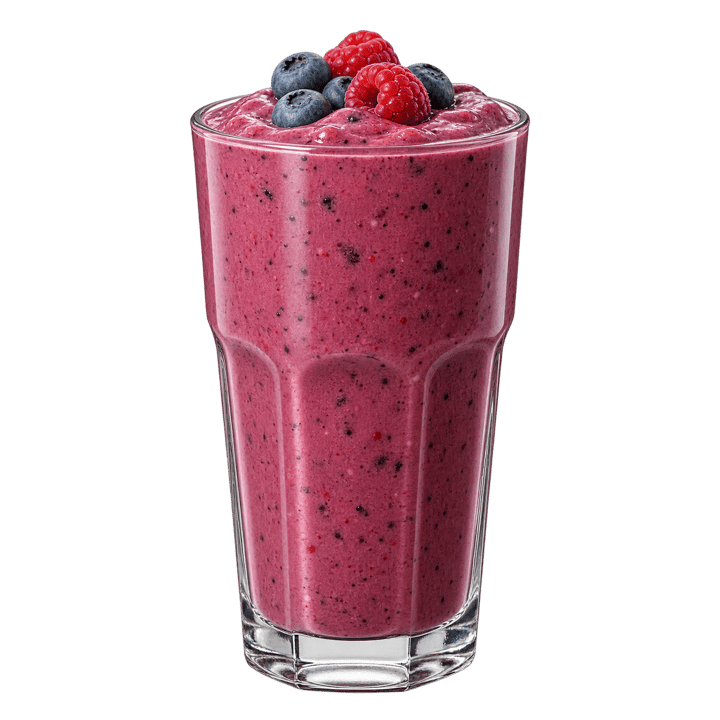
Why am I hungry right after a smoothie?
The apple test: 58 adults, lunch plus what they had first
On this page
You drank fruit and water, fast. A thin drink leaves the stomach quickly, nothing got chewed, and a fruit smoothie has almost no protein. Add about 30 g of protein, make it thick enough to sip slowly, and the same glass lasts until lunch. The Gyroscope app personalizes your protein line.
A big fruit smoothie is a lot of food. It can hold a banana, a cup of strawberries and a cup of juice, more fruit than most people eat in a day, so it seems like it should keep you going. When it doesn’t, people blame a sugar crash or a fast metabolism. The two real reasons are less dramatic. It’s a drink, and it’s missing the part of a meal that holds you.
What we’d do
Put protein in it (7 oz of Greek yogurt and a cup of milk is 28 g), use frozen fruit and less liquid so it’s thick, and drink it slowly, the way you’d eat a bowl of yogurt. If you’re still hungry by mid-morning, add a spoon of chia or a quarter cup of oats before you add more fruit.
Eating an apple takes a few minutes of chewing. Drinking a glass of apple juice takes seconds. The chart at the top of this page shows what that did to lunch.
What happened in the apple test?
In 2009, researchers at Penn State gave 58 adults a snack of about 125 calories, 15 minutes before lunch, once a week for five weeks. It was the same apple each time, served whole, as applesauce, as apple juice, or as juice with the apple’s fiber stirred back in, plus one week with nothing. Everyone took the same 10 minutes to finish it.
After the whole apple, people ate 187 fewer calories in all, apple included, than with nothing first. After the juice they ate 9 fewer. Putting the fiber back into the juice barely helped (35 fewer), so the fiber alone wasn’t the reason. The less the apple had to be chewed, the less it filled people up.
Why does a drink fill you less than food?
Three things are going on.
- Nothing gets chewed. In a 2018 study of 47 adults, people felt fuller after a snack that seemed more like food and that they ate more slowly.
- Thin liquid leaves the stomach fast. In a 2016 study, 15 men drank dairy shakes inside an MRI scanner. A thin 100-calorie shake was half gone from the stomach in 26.5 minutes, and a thin 500-calorie one in 69.5. More calories kept the stomach full longest. Thickness did something else: at 40 minutes the thick 100-calorie shake felt fuller (58 out of 100) than the thin 500-calorie shake (48).
- There’s no protein. A 20 oz Caribbean Way has 2 g of protein (Smoothie King’s menu, November 2026). Adding 30 g of protein gives the glass meal-sized calories without any more sugar, and those calories are what kept the stomach busy longest in the scanner.
Do you eat less later after a smoothie?
Less than you’d hope, and here the science is mixed. In the 2018 study, people felt fuller after the fruit than after the same fruit blended, but when lunch came the calories they ate didn’t differ between the smoothie, the fruit, milk and a sweet drink. People made up for 82% of the snack’s calories when the meal came 2 minutes later, and only 12% when it came 2 hours later. Two hours on, a 136-calorie snack of any kind had stopped doing much.
A study from 2000 shows the long-run version. People who got 450 extra calories a day as soda for four weeks ate no less of anything else and gained weight. With the same calories as jelly beans, they cut back on other food without trying. A glass that’s meant to last until lunch has to be a meal, with a meal’s protein and calories. A small, thin, sweet one works like a snack, and its calories still count.
What to do
- Add protein to reach your line: 25 g at 140 lb, 30 at 165, 35 at 180.
- Make it thick: frozen fruit instead of ice, less liquid, Greek yogurt, oats or chia. How to make a smoothie thicker has the details.
- Sip it slowly, and drink it in place of a meal, never beside one.
- Check your glass in the quiz, Is my smoothie a meal or a dessert? A glass with under 10 g of protein gets the verdict The Fruit Cup, and the one change that fixes it.
bodyfat.guide’s hunger chapter covers what keeps you full on any diet.
5 sources
- Flood-Obbagy JE and Rolls BJ, The effect of fruit in different forms on energy intake and satiety at a meal, Appetite, 2009pmc.ncbi.nlm.nih.gov
- Camps G et al., Empty calories and phantom fullness: a randomized trial studying the relative effects of energy density and viscosity on gastric emptying determined by MRI and satiety, American Journal of Clinical Nutrition, 2016pubmed.ncbi.nlm.nih.gov
- Rogers PJ and Shahrokni R, A comparison of the satiety effects of a fruit smoothie, its fresh fruit equivalent and other drinks, Nutrients, 2018pmc.ncbi.nlm.nih.gov
- DiMeglio DP and Mattes RD, Liquid versus solid carbohydrate: effects on food intake and body weight, International Journal of Obesity, 2000pubmed.ncbi.nlm.nih.gov
- Smoothie King, The Caribbean Way, nutrition facts, 20 oz, opened November 14, 2026smoothieking.com