How do I make a smoothie to gain weight?
On this page
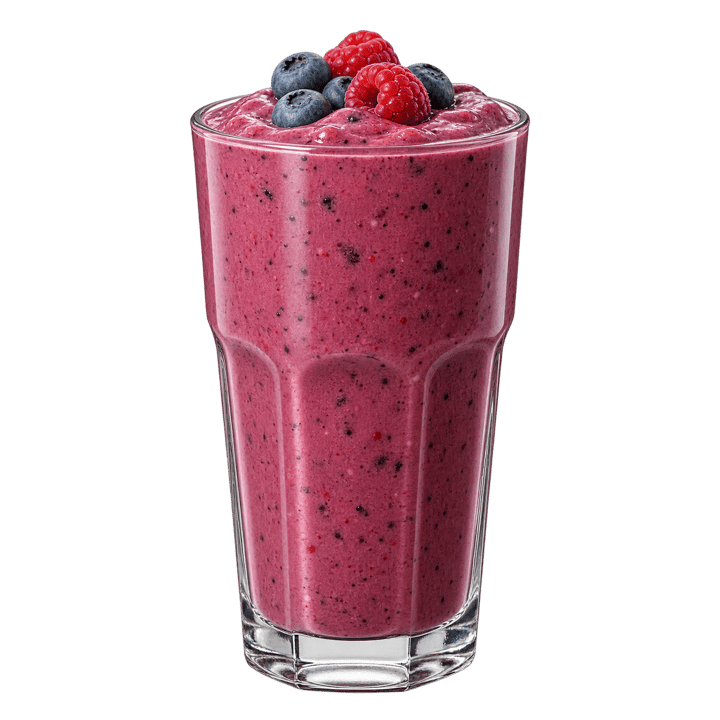
Add the glass to your meals instead of drinking it in place of one, and build it big. A cup and a half of milk, 7 oz of plain Greek yogurt, a banana, a cup of frozen strawberries, two tablespoons of peanut butter, half a cup of oats and a spoon of flax come to about 839 calories and 48 g of protein, with no added sugar.
Everything else on this site tells you to make a smoothie replace a meal, because calories you drink are easy to add without noticing. If you’re trying to gain weight, that’s the same fact working for you. A glass slips past your appetite in a way a second plate of food doesn’t, which is why it’s the easiest way we know to add 800 calories to a day.
What we’d do
Drink one big glass a day on top of your usual meals, between breakfast and lunch or after training, when it won’t take the place of a meal. Build it like a meal, with protein, fruit, oats and nut butter, so the extra weight comes with the protein and minerals your body needs to use it well. Sip it over 20 minutes if a full glass feels like a lot. If you’re losing weight without trying, see your doctor before you start.
Gaining on a glass works like topping up a car with a jerry can. The tank you fill at mealtimes is the same size as before, and the can adds fuel without waiting for the next stop.
The big glass


The weight gain glass A
839 calories, 48 g protein, 14 g fiber, no added sugar
Why does a drink add weight so easily?
In a 2000 study, 15 adults got about 450 extra calories a day for four weeks as soda, and for another four weeks as jelly beans. In the jelly bean weeks they ate less of everything else and made up for all of it. In the soda weeks they ate just as much food as before, and their weight went up. The calories in the drink didn’t register.
The form of the food changes it too. In a 2009 study, 58 adults had about 125 calories of apple before lunch. A whole apple cut the rest of their lunch by 187 calories, apple included. The same apple as juice barely changed what they ate. Food you chew takes up some of the room for the next meal, and a drink mostly doesn’t.
What goes in a glass to gain weight?
| Part | Amount | Calories | Protein |
|---|---|---|---|
| 2% milk | 1 1/2 cups | 183 | 12 g |
| Plain nonfat Greek yogurt | 7 oz | 117 | 20 g |
| Peanut butter | 2 tbsp | 192 | 7 g |
| Rolled oats | 1/2 cup | 152 | 5 g |
| Banana and a cup of frozen strawberries | 1 of each | 158 | 2 g |
| Ground flax | 1 tbsp | 39 | 1 g |
Peanut butter and oats do most of the lifting on calories. Two tablespoons of peanut butter are almost 200 calories, and they barely change how much drink there is to finish. Oats thicken it and add slow carbs. The yogurt and milk bring most of the protein, which you want while you gain, above all if you lift, since that’s what new muscle is built from. The US guidelines put the day’s protein at 1.2 to 1.6 g per kg of body weight, and the high end is the one to aim for while you build. The Gyroscope app personalizes yours.
On our builder this glass clears all six meters of a meal for someone on 2,800 calories a day. On a 2,000 calorie day it would be two meals’ worth, and that’s the point.
Who is it for?
- People who are underweight or have trouble eating enough at meals.
- Older adults with a small appetite. In a Cochrane review of 62 trials with 10,187 older people at risk of malnutrition, protein and energy drinks added a small, steady amount of weight, about 2% on average. Those were shop-bought supplement drinks, and nobody has run the same trial on a homemade glass, but the idea is the same. protein.guide’s page for over 50 has the protein side.
- People who lift and want to gain, where a big glass after training is easier than a fourth meal. protein.guide covers how much protein muscle needs.
When should I see a doctor first?
MedlinePlus calls weight loss unexplained when you lose 10 pounds, or 5% of your normal weight, over 6 to 12 months without knowing why. If that’s you, or you have other symptoms with it, see your doctor before you start adding calories, since the weight loss may have a cause that needs treating.
Once you have a glass you like, snap it once in Gyroscope and log it every morning with one tap, and the day’s calorie bar shows whether you’re eating enough. Here’s how that works.
6 sources
- DiMeglio DP and Mattes RD, Liquid versus solid carbohydrate: effects on food intake and body weight, International Journal of Obesity, 2000pubmed.ncbi.nlm.nih.gov
- Milne AC, Potter J, Vivanti A and Avenell A, Protein and energy supplementation in elderly people at risk from malnutrition, Cochrane Database of Systematic Reviews, CD003288cochrane.org
- Flood-Obbagy JE and Rolls BJ, The effect of fruit in different forms on energy intake and satiety at a meal, Appetite, 2009pmc.ncbi.nlm.nih.gov
- MedlinePlus, US National Library of Medicine, Weight loss, unintentionalmedlineplus.gov
- US Department of Agriculture and US Department of Health and Human Services, Dietary Guidelines for Americans, 2025 to 2030, January 2026cdn.realfood.gov
- USDA FoodData Central, SR Legacy rows by FDC ID: milk, 2% (171267), Greek yogurt, plain nonfat (170894), banana (173944), strawberries, frozen (168173), peanut butter (172470), rolled oats (173904), flaxseed (169414), via nutritionvalue.orgnutritionvalue.org