Build your glass
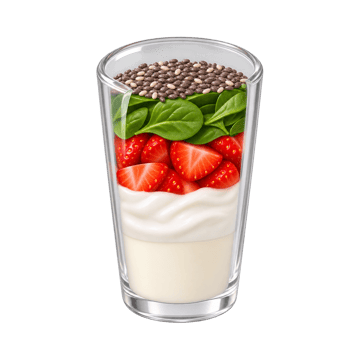
Tap ingredients off the shelves and fix each amount. The glass fills, the vitamin cells light up, the six meters of a meal fill in and the one change that lifts it most shows up.
Graded for 165 lb, 3 meals a day, 2,000 calories a day, as a meal: a protein line of 30 g and a glass of 500 to 830 calories. The Gyroscope app personalizes yours.
What your grade means
A smoothie is a meal you drink, so the builder grades it on the same six jobs Gyroscope grades every meal on. An A means the glass clears all six lines, and you can drink it as breakfast every day if you like. A B+ or lower means at least one meter is short, and the red or orange bar tells you which. Fix that one first with the one change under the meters, and tap Try it to see the new letter. Most glasses are one change from an A, and the change is nearly always protein, a spoon of chia or oats, or a cup of spinach.
If your glass is a treat, a C is fine. The grade is for the glass you drink most mornings.
The six meters
Each meter runs from 0 to 100 and has a line. The grade is the average of the meters, on the same letter cutoffs as the Gyroscope app, and a glass has to clear every line to be an A. A glass that misses one tops out at B+, so a beautiful fruit glass with 4 g of protein can never be an A. For a 165 lb adult eating 2,000 calories a day over three meals, the lines are these:
| Meter | The line | How it works |
|---|---|---|
| Energy | 330 to 830 calories | Your day over your meals, give or take a quarter, is full marks (500 to 830). A lighter glass still passes down to half a meal, and a bigger one falls fast |
| Processing | 70, so 30% of the calories or less ultra-processed | The share of the calories that isn't ultra-processed (NOVA group 4). Whey powder, most plant milks, ice cream, sherbet and granola count. One scoop in a 450 calorie glass passes |
| Muscle | 30 g, your meal line | The 2025 to 2030 US guidelines set 1.2 to 1.6 g of protein per kg a day, with protein at every meal. The low end over three meals (30 g) scores 80 and the high end (40 g) scores 100 |
| Hunger | 80 | Protein (45%), fiber against 14 g per 1,000 calories in the glass (30%), and how much food there is for the calories (25%). The liquid you pour in counts its calories and not its weight, so a thick glass of yogurt and frozen fruit fills this meter and a thin one of milk and powder doesn't |
| Nutrients | 70 | Calcium and potassium, iron, and vitamins A and C, each against the glass's share of the day's calories, plus cups of fruit and leafy greens against the meal's share of the day's servings (1.7 cups) |
| Glucose | 70 | Fast carbs count in full (added sugar, juice and other sweet drinks), slow carbs count half, and the glass's protein and fiber take up to 40% off. About 15 g or less is full marks. Whole fruit stays slow when it's blended, since blended fruit raised finger-stick blood sugar no more than the same fruit eaten whole |
These are the meters meals.guide's plate checker uses, worked out the same way wherever a glass allows, so a smoothie and a plate get graded on one scale. Each has its own page there, from the plate's side: Energy, Processing, Muscle, Hunger, Nutrients and Glucose. Two things differ for a glass. The fiber line comes from the glass's own calories, so a small glass isn't asked for a dinner's fiber. And Nutrients counts five minerals and vitamins where meals.guide counts eight, since thiamin, riboflavin and niacin aren't in the glass's food records.
After a workout and in a small glass on a GLP-1, Energy drops out, since those glasses sit beside meals. A kid's glass drops Energy and Muscle and counts any added sugar against Glucose, since the US guidelines recommend none for young children. A chain cup is graded from its label, and what the label doesn't print (its recipe by weight, its vitamins, and at Jamba its added sugar) gets half marks and counts as a miss.
The letters: A+ over 96, A from 90, B+ over 88, B from 80, C+ over 76, C from 50, D over 40, F at 40 and under. These are this site's meters, set out in full here. The Gyroscope app works out its own, so the numbers won't always match.
The one change
It tries every small edit: add 7 oz of Greek yogurt, a scoop of whey, half a cup of cottage cheese, half an ounce of chia, a tablespoon of ground flax, a quarter cup of oats or a cup of spinach, swap juice for milk or water, leave out the honey, syrup, ice cream or sherbet, and halve the fruit when it's over two portions. It grades each and shows the one that lifts the score most, fixing what's in the glass before adding to it.
The vitamin and mineral cells
Ten cells show the glass's share of the FDA Daily Value for potassium, calcium, vitamin C, magnesium, iron, folate, vitamin A, vitamin K, B12 and vitamin D. A cell is half lit at 10 to 19% ("good source") and fully lit at 20% or more ("high"), the FDA's own label words. Sodium shows only when it passes 20%. One cup of spinach takes vitamin K to 121% for 7 calories.
Where the numbers come from
Each ingredient is a USDA record by its FoodData Central ID, at a US measure with its grams beside it. Your glass is kept in this browser and in the page's address, so a link reopens the same glass.
12 sources
- US Department of Agriculture and US Department of Health and Human Services. Dietary Guidelines for Americans, 2025 to 2030. January 2026cdn.realfood.gov
- US Department of Agriculture. Daily Servings by Calorie Level, Dietary Guidelines for Americans 2025 to 2030cdn.realfood.gov
- Institute of Medicine. Dietary Reference Intakes for Energy, Carbohydrate, Fiber, Fat, Fatty Acids, Cholesterol, Protein, and Amino Acids. 2005 (the fiber basis, 14 g per 1,000 calories)canada.ca
- Schoenfeld BJ, Aragon AA. How much protein can the body use in a single meal for muscle-building? Journal of the International Society of Sports Nutrition, 2018pmc.ncbi.nlm.nih.gov
- Monteiro CA, et al. Ultra-processed foods: what they are and how to identify them. Public Health Nutrition, 2019europepmc.org
- Rolls BJ. The relationship between dietary energy density and energy intake. Physiology and Behavior, 2009pmc.ncbi.nlm.nih.gov
- Crummett LT, Grosso RJ. Postprandial glycemic response to whole fruit versus blended fruit in healthy, young adults. Nutrients, 2022pmc.ncbi.nlm.nih.gov
- US Food and Drug Administration. Daily Value on the Nutrition Facts and Supplement Facts labelsfda.gov
- 21 CFR 101.54, nutrient content claims for "good source" and "high"law.cornell.edu
- USDA FoodData Central, SR Legacy rows by FDC ID, read on nutritionvalue.orgnutritionvalue.org
- Gebhardt SE, Thomas RG. Nutritive Value of Foods. USDA ARS, Home and Garden Bulletin 72, 2002ars.usda.gov
- meals.guide, the plate checker on the same six metersmeals.guide