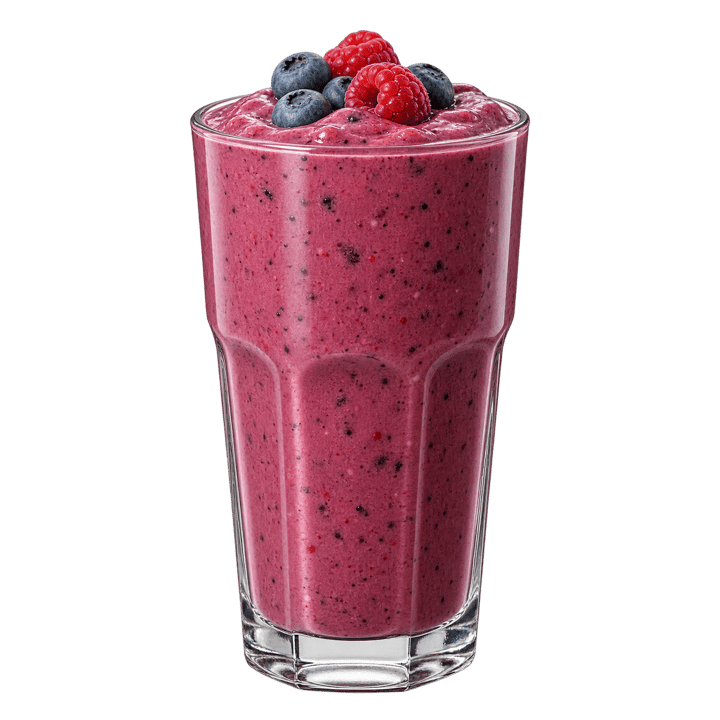
Only the calories decide how full a shake keeps you
Short answerNot the way you think
On this page
Not the way you think. Calories do the most to keep your stomach full: in an MRI study, a thin 500 calorie shake took more than twice as long to half empty as a thin 100 calorie one. But thickness did the most for how full people felt. At 40 minutes, a thick 100 calorie shake was rated fuller than a thin 500 calorie one. A glass that lasts needs both, plus protein.
What we’d do
Give the glass a meal’s calories and make it thick. Use frozen fruit instead of ice, Greek yogurt, a quarter cup of oats or half an ounce of chia, and less liquid than you think. Then sip it over a while instead of drinking it in two minutes. A thin, low calorie glass will feel fine at 8 and leave you hungry at 10.
If you remember three things
- Calories keep the stomach full. The 500 calorie shakes stayed in the stomach far longer than the 100 calorie ones.
- Thickness makes you feel full. Even when there’s less in the stomach, which the researchers called phantom fullness.
- A good glass uses both. A meal’s calories, thick enough to sip, with protein.
Why people believe it
Calorie counting trained everyone to think a calorie is a calorie, and for weight over months, the calories do add up. It seems to follow, then, that 400 calories of anything should hold you as long as 400 calories of anything else. If a smoothie leaves you hungry, the reasoning goes, it didn’t have enough calories.
Part of that is right, and the part that isn’t is what you feel at 10 am.
The MRI study
In 2016 researchers at Wageningen University in the Netherlands gave 15 healthy young men four dairy shakes on four different days. Every shake was 500 ml, with the same mix of carbs, protein and fat. Two were thin and two were thick, and each came at 100 or 500 calories. After drinking, the men lay in an MRI scanner, which measured what was left in their stomachs every 10 minutes for 90 minutes, and they rated how full they felt.
| Shake | Half gone from the stomach | Fullness at 40 minutes |
|---|---|---|
| Thin, 100 calories | 26.5 minutes | |
| Thick, 100 calories | 41 minutes | 58 out of 100 |
| Thin, 500 calories | 69.5 minutes | 48 out of 100 |
| Thick, 500 calories | 81.9 minutes |
Calories slowed the stomach more than thickness did. Going from 100 to 500 calories added about 40 minutes. Going from thin to thick added about 12 to 15. But the men’s own ratings told a different story: the thick 100 calorie shake felt fuller at 40 minutes than the thin 500 calorie one, even though its stomach was emptying faster.
The authors called it “phantom fullness”, fullness that comes from the thickness alone. They suggested it could help people eat less, and they pointed out the flip side: “empty calories in quickly ingested drinks such as sodas” barely register.
Two gauges
Think of a car with two gauges. One shows how much fuel is in the tank. The other is a warning light for how heavy the car feels. Calories fill the tank. Thickness turns on the light. A thin 500 calorie glass fills the tank but you don’t feel it, and a thick 100 calorie glass feels full while the tank runs dry within the hour.
A glass that keeps you going until lunch needs a meal’s calories in the tank and enough thickness that you feel it. That’s why we’d never build a low calorie glass to fool your stomach, and never drink a big thin one in two minutes either.
How fast you drink it counts too
A 2018 study at the University of Bristol gave 47 adults about 136 calories of water, blackcurrant squash, milk, a fruit smoothie, or the smoothie’s fruit eaten whole. The more food-like something seemed, and the more slowly people had it, the fuller they felt. In a 2009 study of 58 adults, the same apple filled people most whole, less as applesauce and least as juice, all at about 125 calories. Calories alone don’t explain either result.
The best case for calories
At the next meal, calories do win. In the Bristol study, every snack with calories in it, the drinks and the fruit alike, cut what people ate at the next meal by the same amount compared with water: about 82% of the snack’s calories when the meal came 2 minutes later, and 12% when it came 2 hours later. How full the snack felt didn’t change that.
Calories decide a lot, and over a day they decide your weight. They just aren’t the only thing that decides how full you feel or how long a glass holds you. A thick 100 calorie glass feels great and runs out fast. A meal’s calories, thick, with protein, is the version that does both jobs.
4 sources
- Camps G, Mars M, de Graaf C and Smeets PA, Empty calories and phantom fullness: a randomized trial studying the relative effects of energy density and viscosity on gastric emptying determined by MRI and satiety, American Journal of Clinical Nutrition, 2016pubmed.ncbi.nlm.nih.gov
- Rogers PJ and Shahrokni R, A comparison of the satiety effects of a fruit smoothie, its fresh fruit equivalent and other drinks, Nutrients, 2018pmc.ncbi.nlm.nih.gov
- Flood-Obbagy JE and Rolls BJ, The effect of fruit in different forms on energy intake and satiety at a meal, Appetite, 2009pmc.ncbi.nlm.nih.gov
- USDA FoodData Central, SR Legacy rows by FDC ID: Greek yogurt, plain nonfat (170894), chia (170554), rolled oats (173904), opened on nutritionvalue.orgnutritionvalue.org