What does blending do to fruit?

 Peak rise in blood sugar, finger stick, mg/dL
20 students, the same apple and blackberries (Crummett and Grosso 2022)

 One smoothie's glycemic index
15 adults, a sensor against fingertip blood (Hutchins 2025)
On this page
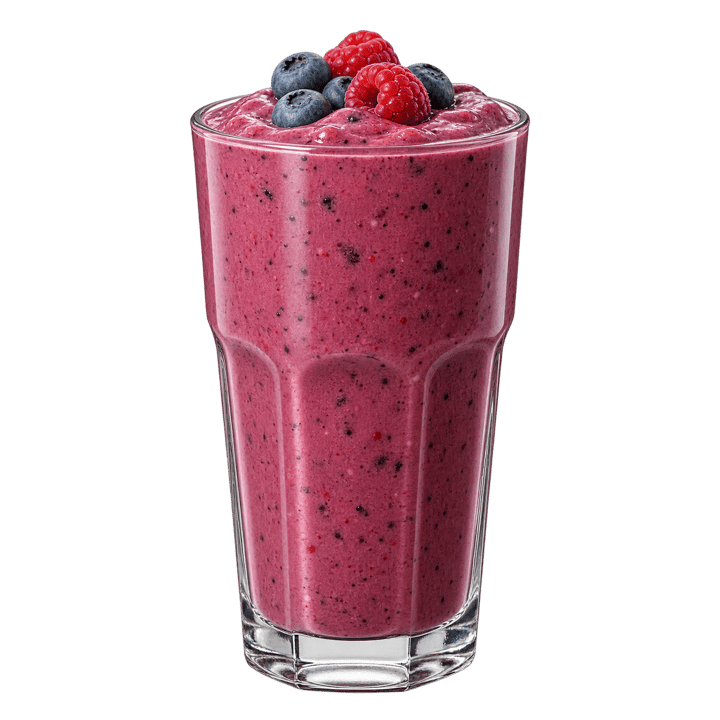
Blending keeps every gram of fiber in the glass, cut into smaller pieces, and it grinds seeds open. Juicing is what takes the fiber out. In a finger-stick trial, blended apple and blackberries raised blood sugar less than the same fruit eaten whole. The real catch is smaller: in one study, a banana’s enzyme broke down most of the flavanols in a smoothie.
Ask around and you’ll hear that a blender “destroys” fiber, turns fruit into sugar water, and spikes your blood sugar like a soda. It sounds right, because blending and juicing get lumped together, and because videos of glucose sensors after a smoothie show a steep curve. Most of it doesn’t hold up once you look at what the blade does and how the curve was measured.
What we’d do
Blend, don’t juice, and keep the skins and seeds: berries, chia and ground flax all go in. When berries or cocoa are the point of the glass, leave the banana out and get the creaminess from Greek yogurt or mango. Drink it the day you make it. If you wear a glucose sensor, don’t judge a smoothie by its curve alone, since sensors run high after drinks.
If you remember three things
- The fiber stays. A smoothie has all of the fruit’s fiber. A cup of orange juice has half a gram.
- By finger stick, blended fruit peaked lower. 28.8 mg/dL against 42.5 for the same fruit eaten whole, in 20 students.
- Sensors make drinks look worse. One put a fruit smoothie at GI 69. Fingertip blood put it at 53.
Shredding against throwing out
Blending fruit is like putting a letter through a shredder. Every word is still in the bin, just in smaller pieces. Juicing is like keeping the ink and throwing the paper away. The pulp, where most of the fiber lives, gets left behind in the juicer.
| In a cup | Fiber | Sugar |
|---|---|---|
| Frozen blueberries, blended | 4.2 g | 13 g |
| Frozen strawberries, blended (5 oz) | 3.2 g | 7 g |
| A medium banana, blended | 3.1 g | 14 g |
| Orange juice | 0.5 g | 21 g |
| Apple juice | 0.5 g | 24 g |
The US guideline says to eat fruit “in their original form” and to have juice “in limited portions or diluted with water”. A smoothie made from whole fruit is much closer to the first.
Blending doesn’t make it the same as eating the fruit, though. In the 2009 apple test, 58 adults had about 125 calories of apple before lunch. A whole apple cut the meal by 187 calories, applesauce by less, and juice by almost nothing. Putting the apple’s fiber back into the juice didn’t help, so chewing does part of the work on its own. Why a smoothie doesn’t fill you like food covers that side.
The finger-stick trial
In 2022 two researchers at Soka University of America, Lisa Crummett and Ryan Grosso, gave 20 healthy college students (12 women and 8 men) the same fruit twice: a 190 g Gala apple with the core and seeds removed and the skin on, plus 148 g of blackberries. One morning they ate it whole. Another morning it was blended. Every 10 minutes for an hour, the students pricked a finger and checked their blood sugar on a meter.
The blended fruit raised blood sugar less. The average peak rise was 42.5 mg/dL after the whole fruit and 28.8 after the smoothie, and the total rise over the hour was about a third lower too. The authors think the blackberry seeds are the reason: whole, most of them pass through untouched, and ground in a blender they release their fiber and other compounds. The study had no outside funding.
It was 20 young, healthy people, one combination of fruit and one hour. It doesn’t show that every smoothie beats every whole fruit. But it’s the opposite of a spike, and the best test of the question we’ve found.
Why a sensor tells a different story
A glucose sensor on your arm measures the fluid between your cells, not your blood, and it lags behind. In a 2025 trial at the University of Bath, 15 healthy adults came in for 7 lab visits wearing a FreeStyle Libre 2, while the researchers took fingertip blood every 15 minutes for comparison. The sensor ran high, about 0.9 mmol/L (about 16 mg/dL), and most of all after drinks and fruit. It put a store-bought fruit smoothie at a glycemic index of 69. Fingertip blood put the same smoothie at 53.
A sensor curve after a smoothie can overstate what happened in your blood. The trial was paid for by an unrestricted grant from Innocent Drinks, a smoothie maker, which had no part in running or writing it. A smoothie spikes your blood sugar more than the fruit goes through both studies, and glucose.guide covers sensors in depth.
These trials were in healthy adults. If you have diabetes, who should build it differently has the version for you, and your care team sets your carbs.
The banana and the flavanols
Here’s where blending does change something. Flavanols are plant compounds in berries, apples, cocoa and tea, linked in studies to heart and blood vessel health. Bananas carry a lot of an enzyme called polyphenol oxidase, the one that turns a cut banana brown, and it breaks flavanols down.
In a 2023 study, 8 healthy men drank flavanols three ways: added to a banana smoothie, added to a mixed berry smoothie, or in a capsule. The capsule and the berry smoothie gave about the same peak in the blood. The banana smoothie gave 84% less. In a second test with 11 people, the researchers kept the flavanols apart from the banana drink until it was swallowed, and the levels still fell, which points to the enzyme working in the stomach.
It was a small study of one family of compounds, the flavanols were added to the drinks rather than coming from the fruit, and Mars, which sells cocoa flavanol products, paid for it, with three of its employees among the nine authors. Bananas still bring potassium (422 mg in a medium one), creaminess and sweetness with no added sugar. Does banana ruin a smoothie? has our take.
Why a smoothie turns brown
The browning is the same enzyme meeting air, like a sliced apple or banana left on the counter. It changes the color and some of the taste. We’d drink a smoothie the day it’s made and keep it cold until then. For more days, freeze the fruit and the seeds in bags and blend each morning. How long does a smoothie last in the fridge? has the details.
6 sources
- Crummett LT and Grosso RJ, Postprandial glycemic response to whole fruit versus blended fruit in healthy, young adults, Nutrients, 2022pmc.ncbi.nlm.nih.gov
- Hutchins KM, Betts JA, Thompson D, Hengist A and Gonzalez JT, Continuous glucose monitor overestimates glycemia, with the magnitude of bias varying by postprandial test and individual: a randomized crossover trial, American Journal of Clinical Nutrition, 2025pmc.ncbi.nlm.nih.gov
- Ottaviani JI et al., Impact of polyphenol oxidase on the bioavailability of flavan-3-ols in fruit smoothies: a controlled, single blinded, cross-over study, Food and Function, 2023europepmc.org
- Flood-Obbagy JE and Rolls BJ, The effect of fruit in different forms on energy intake and satiety at a meal, Appetite, 2009pmc.ncbi.nlm.nih.gov
- US Department of Agriculture and US Department of Health and Human Services, Dietary Guidelines for Americans, 2025 to 2030, January 2026cdn.realfood.gov
- USDA FoodData Central, SR Legacy rows by FDC ID: orange juice (169098), apple juice (173933), banana (173944), frozen strawberries (168173), frozen blueberries (173950), opened on nutritionvalue.orgnutritionvalue.org