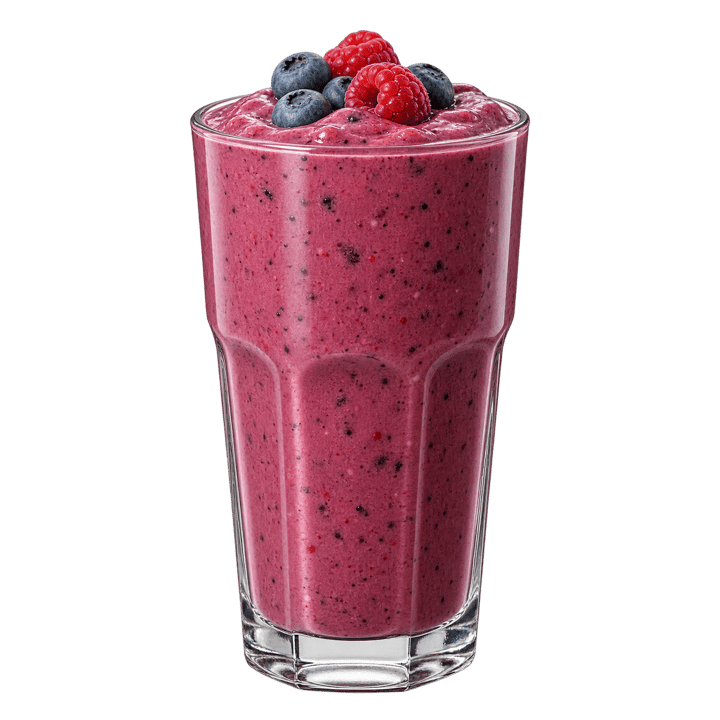
A smoothie spikes your blood sugar more than eating the fruit
Short answerNot the way you think

 Peak rise in blood sugar, finger stick, mg/dL
20 students, the same apple and blackberries (Crummett and Grosso 2022)

 One smoothie's glycemic index
15 adults, a sensor against fingertip blood (Hutchins 2025)
On this page
Not the way you think. Measured in fingertip blood, blended apple and blackberries raised blood sugar less than the same fruit eaten whole, with a peak of 28.8 mg/dL against 42.5 in 20 students. Glucose sensors make drinks look worse than they are: one put a fruit smoothie at a glycemic index of 69, where fingertip blood put it at 53.
What we’d do
Don’t give up on smoothies because of a sensor curve. Build the glass to be gentle anyway: whole fruit, berries more than mango, no juice or honey, and protein and fiber in every glass. If you have diabetes, use a finger stick to see how a glass suits you, and let your care team set your carbs.
If you remember three things
- The blender doesn’t make fruit spike. By finger stick, blended fruit peaked lower than whole.
- Sensors run high after drinks. About 16 mg/dL high, in a 2025 trial.
- What’s in the glass decides it. Juice, honey and turbinado add sugar. Protein and fiber slow it down.
Why people believe it
It makes intuitive sense. A drink goes down fast, so the sugar must hit fast. Juice really does have its fiber removed, and smoothies get lumped in with it. Videos of glucose sensors after a smoothie show steep curves. Even Gyroscope’s own Restaurant and Fast Food Guide once said smoothies make blood sugar “spike and crash”. Its advice on what to order still holds, but the studies since then point the other way on the spike.
What the studies found
Whole fruit or blended, by finger stick
20 healthy college students (12 women, 8 men). Crummett and Grosso, Soka University of America, 2022
A 190 g Gala apple and 148 g of blackberries, eaten whole one morning and blended another. Peak rise: 42.5 mg/dL whole, 28.8 blended. The total rise over the hour was about a third lower blended too.
Young, healthy people, one fruit mix, one hour. The authors credit the ground blackberry seeds, so fruit without seeds may differ. No outside funding.
A sensor against fingertip blood
15 healthy adults, 7 lab visits each. Hutchins and colleagues, University of Bath, 2025
A FreeStyle Libre 2 sensor ran about 0.9 mmol/L (about 16 mg/dL) above fingertip blood, most of all after drinks and fruit. It put a store-bought fruit smoothie at GI 69. Fingertip blood put it at 53.
Healthy adults and one sensor model. Paid for by an unrestricted grant from Innocent Drinks, a smoothie maker, which had no role in the study.
Two ways to measure the same glass
Think of a glucose sensor as a thermometer hung in the hallway instead of the room you care about. It measures the fluid around your cells, not the blood itself, and it catches up a few minutes late. Most of the time it’s close enough. After a fast drink, the 2025 trial found, the hallway runs hot.
Fingertip blood is the room. Measured there, the blended fruit in the 2022 trial gave a smaller rise than the whole fruit, which is the opposite of a spike. A sensor curve after a smoothie can show a bigger rise than happened in your blood, and that’s where a lot of the spike story comes from.
The part that’s true
The spike story is right about one thing: a glass full of sugar raises blood sugar. A 20 oz Caribbean Way at Smoothie King has 83 g of sugar, 50 of them added from a papaya juice blend and turbinado. No study above tested a cup like that, and nothing about the blender makes that sugar gentle.
A blender doesn’t make fruit worse for blood sugar. What you blend with it changes what happens.
- Juice brings sugar without the fiber. A cup of orange juice has 21 g of sugar and half a gram of fiber.
- Honey, syrup and turbinado are added sugar. The US guideline’s line for a whole meal is 10 g.
- Protein and fiber come along with the fruit in a well-built glass: Greek yogurt or a scoop, and a spoon of chia, flax or oats.
If you have diabetes
The trials above were in healthy adults, so they don’t tell you how your own blood sugar will respond. A glass built on berries, protein and fiber, with no juice, honey or dates, is a reasonable place to start. A finger stick before and an hour or two after will tell you more than a sensor will about a drink. If you take insulin or a sulfonylurea, your care team sets your carbs. Who should build it differently has more, and glucose.guide covers whole fruit and sensors from the blood sugar side.
5 sources
- Crummett LT and Grosso RJ, Postprandial glycemic response to whole fruit versus blended fruit in healthy, young adults, Nutrients, 2022pmc.ncbi.nlm.nih.gov
- Hutchins KM, Betts JA, Thompson D, Hengist A and Gonzalez JT, Continuous glucose monitor overestimates glycemia, with the magnitude of bias varying by postprandial test and individual: a randomized crossover trial, American Journal of Clinical Nutrition, 2025pmc.ncbi.nlm.nih.gov
- US Department of Agriculture and US Department of Health and Human Services, Dietary Guidelines for Americans, 2025 to 2030, January 2026cdn.realfood.gov
- Smoothie King, The Caribbean Way, 20 oz, menu page, opened November 14, 2026smoothieking.com
- Gyroscope, Restaurant and Fast Food Guide, Smoothies and Juice Barsgyrosco.pe