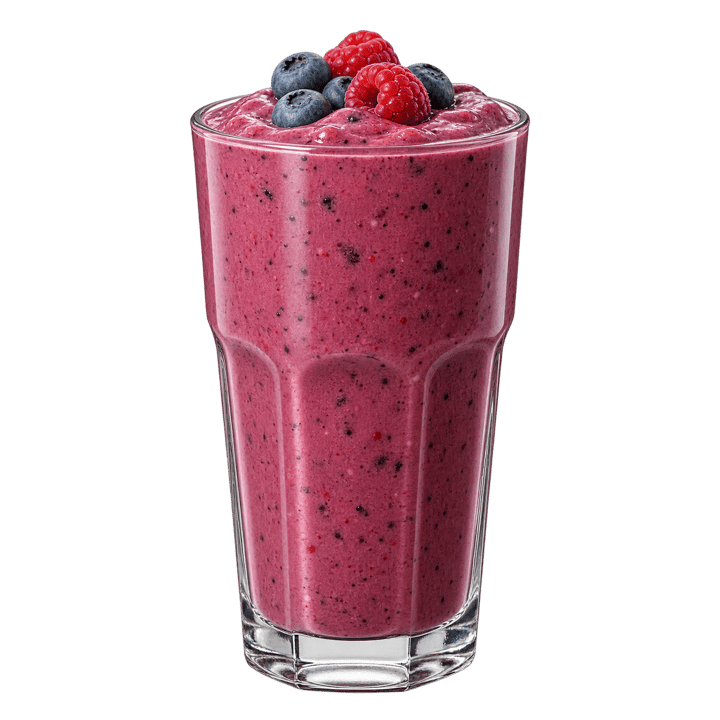
Blending destroys the fiber in fruit
Short answerNo
On this page
No. A blender cuts fiber into smaller pieces, and every gram of it stays in the glass. Juicing is what takes the fiber out: a cup of orange juice has half a gram. Blending does change how filling the fruit is, though, so build the glass to make up for it.
What we’d do
Blend, never juice. Keep the skins and the seeds, and add more of them: berries, chia and ground flax all bring fiber that survives the blade. Then make up for what blending does change, which is how fast the glass goes down, with protein and enough thickness to sip it slowly.
If you remember three things
- Blending keeps the fiber. A cup of frozen blueberries has 4.2 g, blended or not.
- Juicing removes it. A cup of orange or apple juice has half a gram.
- Blending grinds seeds open. That may be why blended berries raised blood sugar less in one trial.
Why people believe it
The idea comes from three places. Juicing and blending get talked about as one thing, and juice really has lost its fiber. Some wellness writers say the blade “breaks” or “destroys” the fiber’s structure, which sounds technical. And people notice that a smoothie doesn’t fill them like a bowl of fruit, so something must have been lost.
The last one is true. What changed is the form of the fruit, and the amount of fiber stayed the same.
Shredding against throwing out
Blending is like putting a letter through a shredder. Every word is still in the bin, in smaller pieces. Juicing keeps the ink and throws the paper away: the pulp, where most of the fruit’s fiber is, stays in the juicer.
| In a cup | Fiber | Sugar |
|---|---|---|
| Frozen blueberries, blended | 4.2 g | 13 g |
| Frozen strawberries, blended (5 oz) | 3.2 g | 7 g |
| A medium banana, blended | 3.1 g | 14 g |
| Orange juice | 0.5 g | 21 g |
| Apple juice | 0.5 g | 24 g |
Fiber is counted by what’s in the food, and the blender takes nothing away. A glass with a cup of blueberries, a banana and half an ounce of chia carries about 12 g of fiber whether you blend it, mash it or eat it with a spoon.
What the studies found
Whole or blended, same fruit
20 healthy college students, finger stick every 10 minutes for an hour. Crummett and Grosso, Soka University of America, 2022
A Gala apple and 148 g of blackberries raised blood sugar less when blended: a peak of 28.8 mg/dL against 42.5 whole. The authors think grinding the blackberry seeds released their fiber and other compounds.
One fruit mix, one hour, young healthy adults, no outside funding.
Apple, applesauce or juice
58 adults, a 125 calorie apple snack before lunch, once a week for five weeks. Flood-Obbagy and Rolls, 2009
The whole apple cut lunch plus apple by 187 calories. Applesauce did less, juice almost nothing, and juice with the apple’s fiber stirred back in did no better than plain juice.
Applesauce isn’t a smoothie, and it was one snack before one meal.
The two studies fit together. In the first, blending made more of the fruit’s fiber available, by grinding seeds a person would otherwise swallow whole. In the second, putting fiber back into juice didn’t bring back the fullness of a whole apple, so chewing and the form of the food count on top of the fiber.
The best case for the myth
People who say blending ruins fruit have a point about fullness. In the apple study, applesauce, which is apple with the chewing done for you, filled people less than the whole apple. A smoothie is in the same spot. It has all the fiber and still goes down faster than food you chew.
We’d build the glass to make up for it and keep blending. Protein, a spoon of chia or oats and frozen fruit make it thick enough to sip slowly, and a thick shake felt fuller than a thin one in a 2016 MRI study, even with a fifth of the calories. Why a smoothie doesn’t fill you like food has that study.
The 2025 to 2030 US guideline says to eat fruit “in their original form” and to keep juice to “limited portions or diluted with water”. A smoothie made from whole fruit keeps everything but the shape, which puts it far closer to the first than the second.
5 sources
- Crummett LT and Grosso RJ, Postprandial glycemic response to whole fruit versus blended fruit in healthy, young adults, Nutrients, 2022pmc.ncbi.nlm.nih.gov
- Flood-Obbagy JE and Rolls BJ, The effect of fruit in different forms on energy intake and satiety at a meal, Appetite, 2009pmc.ncbi.nlm.nih.gov
- Camps G, Mars M, de Graaf C and Smeets PA, Empty calories and phantom fullness: a randomized trial studying the relative effects of energy density and viscosity on gastric emptying determined by MRI and satiety, American Journal of Clinical Nutrition, 2016pubmed.ncbi.nlm.nih.gov
- US Department of Agriculture and US Department of Health and Human Services, Dietary Guidelines for Americans, 2025 to 2030, January 2026cdn.realfood.gov
- USDA FoodData Central, SR Legacy rows by FDC ID: orange juice (169098), apple juice (173933), banana (173944), frozen strawberries (168173), frozen blueberries (173950), chia (170554), opened on nutritionvalue.orgnutritionvalue.org