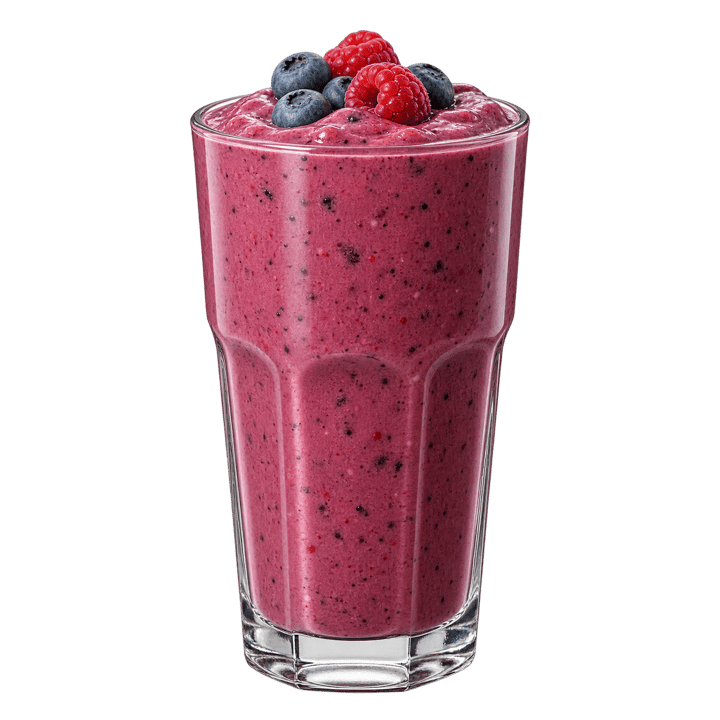
Banana ruins the nutrients in a smoothie
Short answerNot the way you think
On this page
Not the way you think. In a 2023 study of 8 men, flavanols drunk in a banana smoothie reached the blood at levels 84% lower than from a capsule, while a berry smoothie matched the capsule. That’s one family of plant compounds, in one small study that Mars paid for. Banana still brings potassium, fiber and creaminess with no added sugar.
What we’d do
Keep the banana in most glasses. When the point of the glass is the flavanols in berries or cocoa, leave it out and get the creaminess from Greek yogurt, mango or oats. A frozen banana is still the best sweetener there is for a glass with no added sugar.
If you remember three things
- Banana’s enzyme broke down flavanols. 84% less reached the blood, in 8 men.
- It’s one family of compounds. Protein, fiber, vitamins and minerals weren’t part of the study.
- A medium banana is still a good ingredient. 105 calories, 3 g of fiber, 422 mg of potassium and no added sugar.
Why people believe it
In 2023 researchers from Mars and the University of California, Davis published a study on banana smoothies, and the story that spread from it was that bananas ruin a smoothie. The finding was real and surprising, and the banana is in almost every smoothie, so it stuck. Somewhere along the way “less of one plant compound” became “ruins the nutrients”.
What a cut banana is telling you
Leave a sliced banana on the counter and it turns brown. That’s an enzyme called polyphenol oxidase meeting air. Bananas carry a lot of it, and in the jar it gets to work on the plant compounds around it.
Flavanols are one family of those compounds. They’re in cocoa, tea, apples and berries, and they’re studied for heart and blood vessel health. The question the researchers asked was simple: if you blend flavanols with a banana, how much reaches your blood?
What the study found
Banana, berries or a capsule
8 healthy men, a crossover, each trying all three. Ottaviani and colleagues, 2023
The same dose of flavanols, added to a banana smoothie, added to a mixed berry smoothie, or in a capsule. The capsule gave a peak blood level of 680 nmol/L, and the berry smoothie about the same. The banana smoothie gave 96, which is 84% lower.
8 men, one sitting each, and the flavanols were added to the drinks rather than coming from the fruit.
Kept apart until swallowed
11 people, same research team
This time the flavanols didn’t touch the banana drink until it was swallowed. Blood levels still fell, which points to the banana’s enzyme working in the stomach too.
A small follow-up within the same paper.
The team also measured the enzyme in 18 fruits, vegetables and other plant foods and found a wide range. The mixed berry drink was their low-enzyme glass, which is why it matched the capsule.
The study’s funding is part of the story. Mars, Inc., which sells cocoa flavanol products, was the grant agency, and three of the nine authors work for Mars. That doesn’t make the result wrong, and it was a controlled, single blinded crossover. But it was paid for by a company with an interest in flavanols.
The part the headlines skipped
The study measured flavanols. It didn’t measure protein, fiber, potassium, vitamin C or anything else in the glass, and an enzyme that breaks down flavanols does nothing to the 30 g of protein from your Greek yogurt.
A medium banana has 105 calories, 14 g of sugar (none of it added), 3 g of fiber and 422 mg of potassium, according to USDA. Frozen, it makes a glass thick, cold and sweet without honey. For most people’s most common smoothie, which is breakfast with fruit in it, the banana is doing its job.
When to leave it out
If you’re drinking a smoothie for its flavanols, it makes sense to keep them away from a banana. That’s a berry glass or a cocoa glass where those compounds are the point.
Our own top ten has two glasses with banana and cocoa together, The Ultimate and the mocha. In those the cocoa is there for chocolate flavor and 2 g of fiber a spoon, so we kept the half banana. If cocoa flavanols are why you drink it, swap the banana for 7 oz of Greek yogurt or half a cup of mango. The blueberry oat and plant glasses have berries and no banana at all.
Mango brings its own sugar, so count it: a cup has 23 g against a banana’s 14. Half a cup does the same job. What can I use instead of banana? has more swaps.
3 sources
- Ottaviani JI, Ensunsa JL, Fong RY, Kimball J, Medici V, Kuhnle GGC, Crozier A, Schroeter H and Kwik-Uribe C, Impact of polyphenol oxidase on the bioavailability of flavan-3-ols in fruit smoothies: a controlled, single blinded, cross-over study, Food and Function, 2023europepmc.org
- USDA FoodData Central, SR Legacy rows by FDC ID: banana (173944), frozen blueberries (173950), mango (169910), Greek yogurt, plain nonfat (170894), opened on nutritionvalue.orgnutritionvalue.org
- US Department of Agriculture and US Department of Health and Human Services, Dietary Guidelines for Americans, 2025 to 2030, January 2026cdn.realfood.gov