Is whey or plant protein powder better?
On this page
Whey, for most people. It has more leucine, the amino acid most tied to muscle building (about 11% of its protein, against about 7% for soy and pea), and in Consumer Reports’ 2025 tests plant powders averaged about nine times the lead of dairy ones. If you’re plant-based, soy is the one with the trial record: it matched milk for muscle in 17 trials.
Plant powders often look like the cleaner, more natural choice. Then Consumer Reports put 23 powders and shakes through a lab in 2025, and the plant ones came out with the most lead on average. The protein itself holds up better than that headline suggests, at least for soy.
What we’d do
If you use a powder, use a dairy one like whey, and not every day, which is Consumer Reports’ own advice. If you avoid dairy, get your protein from soy milk and tofu in the glass, and if you want a plant powder, pick soy over the rest. Most days we’d skip powder entirely, since milk, Greek yogurt and cottage cheese do the same job.
Soy and pea protein are like a smaller coin of the same currency. They pay the same bill, it just takes more of them: about 40 g of soy protein to match the leucine in 25 g of whey.
How do whey, soy and pea compare?
| Whey | Soy | Pea | |
|---|---|---|---|
| Leucine, share of the protein | about 11% | about 7% | about 7% |
| Protein for 2.7 g of leucine | 25 g | about 40 g | about 38 g |
| Muscle in trials | the reference | matched milk in 17 trials | less than animal protein, along with other non-soy plants |
| Lead in Consumer Reports’ 2025 tests | dairy averaged the lowest | plant powders averaged about nine times dairy |
The leucine numbers come from a 2018 lab analysis of plant protein isolates against whey and milk proteins. Plant proteins averaged 7.1% leucine and animal proteins 8.8%, with whey at about 11%.
Does plant protein build as much muscle?
Soy does. A 2025 review of 43 trials found plant protein gave slightly less muscle mass than animal protein overall. Broken down, soy against milk showed no difference across 17 trials, while the other plant proteins came out lower. Strength didn’t differ, and in people over 60 the gap in muscle mass was too small to be sure of.
That makes a soy shake a fair swap for a dairy one. Pea, rice and blends have less evidence behind them, and you’d want more protein per glass to make up for the lower leucine. protein.guide covers plant protein across the whole day.
How much lead was in the powders?
Consumer Reports measured lead per serving against its level of concern, 0.5 micrograms a day, which is cautious and has a wide safety margin. More than two thirds of the 23 products went over it. Plant-based products averaged about nine times the lead of dairy ones and twice that of beef-based ones. Dairy-based products generally had the lowest amounts, but CR still advised against daily use for half of the products it tested. It also said there’s “no reason to panic,” and that the highest levels were far below what causes immediate harm. There’s no federal limit for lead in protein powder. Our myth page on lead has the details.
What’s the plant-based shake without powder?
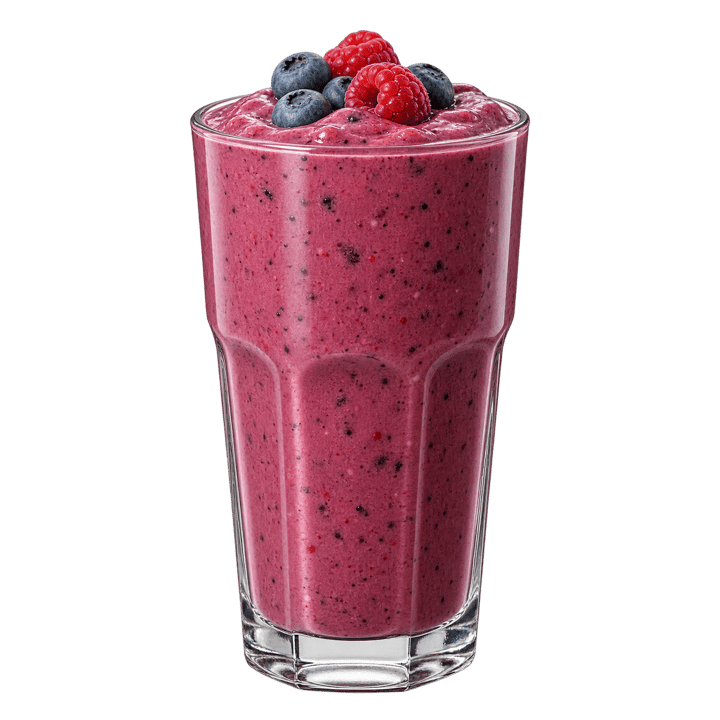
A cup of unsweetened soy milk (7 g) and half a cup of firm tofu (about 22 g) gets you to 29 g. Our plant glass adds a cup of frozen blueberries, half a cup of strawberries and a tablespoon of peanut butter, for 33 g of protein and an A on all six meters at 165 lb. How to make a protein shake without powder has the dairy versions too.
5 sources
- Gorissen SHM et al., Protein content and amino acid composition of commercially available plant-based protein isolates, Amino Acids, 2018pmc.ncbi.nlm.nih.gov
- Reid-McCann RJ et al., Effect of plant versus animal protein on muscle mass, strength, physical performance, and sarcopenia: a systematic review and meta-analysis of randomized controlled trials, Nutrition Reviews, 2025pmc.ncbi.nlm.nih.gov
- Consumer Reports, Protein powders and shakes contain high levels of lead, October 14, 2025, updated January 8, 2026consumerreports.org
- USDA SR Legacy, soymilk, unsweetened (FDC 175223)fdc.nal.usda.gov
- USDA SR Legacy, tofu, firm (FDC 172475)fdc.nal.usda.gov