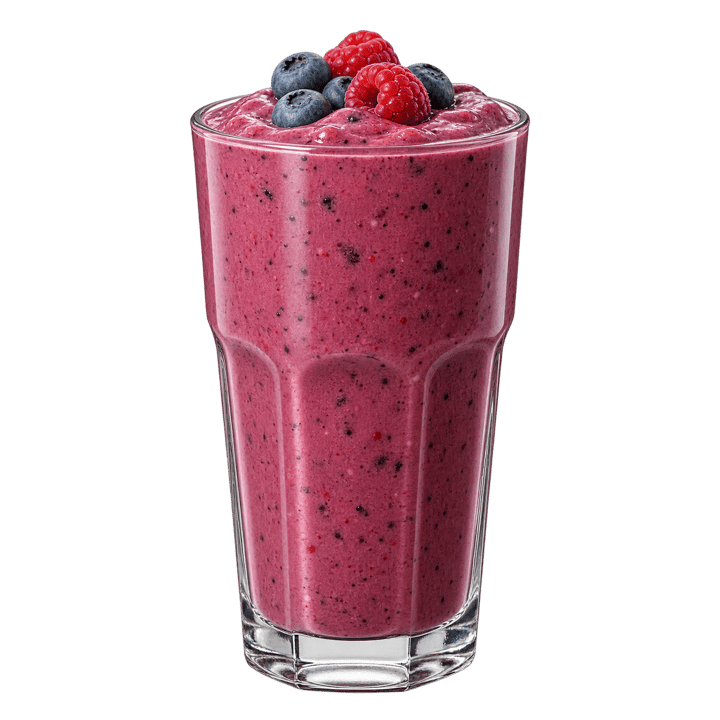
Replacing meals with shakes never works long term
Short answerNo
On this page
No. Across 23 trials with 7,884 adults, people on diets that replaced some meals with products like shakes and bars lost about 3 lb (1.44 kg) more at one year than people on other diets. The shakes took the place of meals. No trial tested a shake added on top of meals, or a homemade glass.
What we’d do
If you want to lose weight with a smoothie, use it the way the trials did: one glass in place of one meal, the same recipe most days, with known calories and enough protein to hold you. Keep the other meals real food. Never add a shake as a snack on top of breakfast.
If you remember three things
- Meal replacements worked at a year. About 3 lb more lost than other diets, in 23 trials.
- They replaced meals. A shake added to your usual meals is extra calories.
- Homemade glasses weren’t tested. So build yours like the ones that were: fixed, known and filling.
Why people believe it
Most people have heard of a liquid diet that didn’t last. There are the crash diets of the past, the shake plans that leave you starving, and the friend who lost weight on shakes and gained it back. It feels like the kind of quick fix that can’t work over time. The authors of the biggest review note that clinical guidelines for obesity generally don’t recommend meal replacements.
The trials say otherwise, as long as you’re clear about what “meal replacement” meant in them.
A fixed menu at lunch
A meal replacement works a bit like a fixed menu at lunch. You know exactly what you’re getting and how much, and you don’t have to decide or count every day. A homemade glass can copy that, as long as it’s the same recipe most days.
What the trials found
23 trials, at one year
7,884 adults with overweight or obesity. Astbury and colleagues, University of Oxford, 2019
Diets with meal replacements lost 1.44 kg (about 3 lb) more than other diets, with a range of 0.39 to 2.48 kg. With the same support in both groups, 2.22 kg more. With extra support on top, 6.13 kg more than other diets with regular support.
Only 6 of the 23 trials were judged at low risk of bias in every area. Very low calorie diets and total diet replacement were left out.
Soda or jelly beans, 4 weeks each
15 adults (7 men, 8 women). DiMeglio and Mattes, Purdue University, 2000
An extra 450 calories a day as jelly beans made people eat less of everything else, enough to cover it. The same calories as soda didn’t, and their weight went up only in the soda weeks.
Soda, not a shake, and a small study.
In the Oxford review, a meal replacement meant a product used in place of at least one meal a day, with at least one ordinary meal kept. That included shakes, bars, soups and portion-controlled meals. Some trials replaced two of the three main meals with shakes or bars. Nerys Astbury and her colleagues concluded that programs with meal replacements “should be considered as a valid option” for weight loss.
In place of a meal
Every trial in the review swapped meals out. None added a shake on top of a normal day. The soda study shows why that’s the line. Calories you drink alongside your usual food tend not to make you eat less of anything else, so they stack up.
That’s the rule we build the whole site around. A smoothie is a meal or nothing. Have it as breakfast or lunch, and keep it out of the gap between them.
The best case for the myth
The skeptics have fair points. About 3 lb more at a year is a real result, but it’s modest, and the range runs from under 1 lb to about 5.5 lb. The review measured weight at one year, so it doesn’t tell you what happens at five. The biggest gap, 6.13 kg, came with extra coaching, so the coaching did part of the work. And the products were packaged, with the same calories every time. No trial tested a homemade smoothie, where the recipe can drift.
We think a homemade glass can do the same job if it’s built like the ones in the trials: the same recipe most days, protein at your meal line (30 g at 165 lb, and the Gyroscope app personalizes yours), and a meal’s calories. How to use a smoothie to lose weight has four glasses that fit a 1,600 calorie day, and bodyfat.guide’s protein calculator gives your range for the whole day, so you keep muscle while you lose.
3 sources
- Astbury NM et al., A systematic review and meta-analysis of the effectiveness of meal replacements for weight loss, Obesity Reviews, 2019pmc.ncbi.nlm.nih.gov
- DiMeglio DP and Mattes RD, Liquid versus solid carbohydrate: effects on food intake and body weight, International Journal of Obesity, 2000pubmed.ncbi.nlm.nih.gov
- USDA FoodData Central, SR Legacy rows by FDC ID (the top ten recipes' ingredients), opened on nutritionvalue.orgnutritionvalue.org