What smoothie helps you lose weight?
On this page
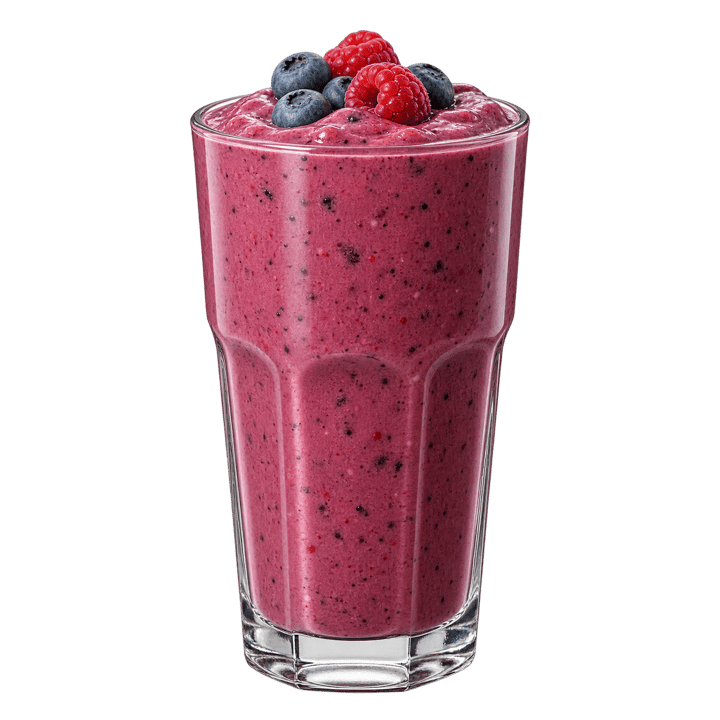
One that replaces a meal. Build it with about 30 g of protein (the line for a 165 lb adult), a spoon of chia, flax or oats, one or two portions of whole fruit and no juice or honey, then drink it instead of breakfast or lunch. Replacing meals is what worked in the trials. The Gyroscope app personalizes yours.
Search for a weight loss smoothie and you get a list of ingredients that supposedly melt fat: green tea, ginger, grapefruit, cinnamon. Then people drink the glass next to breakfast, as a healthy extra. That’s the one way a smoothie reliably makes weight loss harder, because a drink you add is just more food, and your body is bad at noticing food you drink.
What we’d do
Pick the one meal you’d happily stop cooking, usually breakfast, and make the glass that meal every day. Hit your protein line, keep it inside a meal’s calories, and never drink it beside the meal it was meant to replace. The swap does the work, whatever you put in the blender.
It’s like a lunch order. Trading your usual burrito for a smaller one helps. Ordering a second, smaller lunch doesn’t, however healthy it is.
The easy one


Strawberry banana yogurt A
396 calories, 30 g protein, no added sugar
The big one
Peanut butter banana oat A
564 calories, 35 g protein, no added sugar
What did the trials find?
In 2019 a team pooled 23 trials with 7,884 adults with overweight or obesity. People on diets that replaced some meals with a ready-made meal replacement, such as a shake, lost about 3 lb (1.44 kg) more at a year than people on other diets. With extra support from a coach it was about 13 lb (6.13 kg) more. Every one of those trials used shop-bought products, and none tested a homemade smoothie. The homemade glass borrows their rule, which is to replace.
The other half of the story is what happens when you add. In a 2000 study, 15 adults got about 450 extra calories a day for four weeks as soda, and for another four weeks as jelly beans. In the jelly bean weeks they ate less of everything else and made up for all of it. In the soda weeks they ate just as much as before, and their weight went up. Liquid calories slip past the part of you that keeps count, which is exactly why a smoothie has to take a meal’s place.
How big should the glass be?
About a third of your day if you eat three meals, give or take a quarter. Here’s what that means on a few common days.
| Your day | One meal of three | A glass that fits |
|---|---|---|
| 1,400 calories | 350 to 580 | Strawberry banana yogurt, 396 |
| 1,600 calories | 400 to 670 | The Ultimate, 448 |
| 2,000 calories | 500 to 830 | Peanut butter banana oat, 564 |
If you don’t know your day, tdee.guide works it out from your steps. A glass a little under the window is fine on a weight loss day, as long as the protein is there.
Why does protein come first?
Protein is the part a fruit smoothie leaves out, and the part that turns it into a meal. A 2018 review worked out about 0.4 g of protein per kg of body weight at a meal for muscle, which is 25 g at 140 lb, 30 at 165 and 35 at 180. On a diet, eating enough protein helps you keep the muscle you have while the fat comes off. bodyfat.guide covers how much protein to eat while you lose.
The fiber and the thickness help too. A spoon of chia or a quarter cup of oats makes the glass thick enough to sip slowly, and the hunger page explains why that changes how full you feel.
What to do
- Replace one meal a day, the same one, so it becomes a habit you don’t think about.
- Reach your protein line with milk and Greek yogurt, cottage cheese or a scoop.
- Keep the fruit whole, two portions at most, and leave out the juice and honey.
- Check your own glass in the builder, or take the two-minute quiz, Is my smoothie a meal or a dessert?
Snap your shake once, then log it every morning with one tap. Here’s how it works in Gyroscope.
4 sources
- Astbury NM et al., A systematic review and meta-analysis of the effectiveness of meal replacements for weight loss, Obesity Reviews, 2019pmc.ncbi.nlm.nih.gov
- DiMeglio DP and Mattes RD, Liquid versus solid carbohydrate: effects on food intake and body weight, International Journal of Obesity, 2000pubmed.ncbi.nlm.nih.gov
- Schoenfeld BJ and Aragon AA, How much protein can the body use in a single meal for muscle-building? Implications for daily protein distribution, Journal of the International Society of Sports Nutrition, 2018pmc.ncbi.nlm.nih.gov
- US Department of Agriculture and US Department of Health and Human Services, Dietary Guidelines for Americans, 2025 to 2030, January 2026cdn.realfood.gov